1

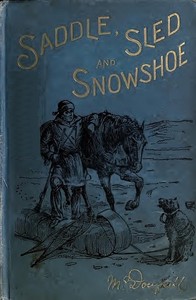
Saddle, Sled and Snowshoe: Pioneering on the Saskatchewan in the Sixties — Edition Insights
24
14
Project Gutenberg
2020
Northwest, Canadian -- Description and travel; Frontier and pioneer life -- Northwest, Canadian; McDougall, John, 1842-1917; Frontier and pioneer life -- Saskatchewan Valley
Readers of public-domain and historical texts
Project Gutenberg digital edition
en
Edition facts
Words: 68,306
Reading time: 297 min
Text sections: 6
Source:
Project Gutenberg record #61659
John McDougall's 1896 memoir recounts his travels by saddle, sled, and snowshoe across the Saskatchewan region in the 1860s, with precise observations of camp life, river crossings, and encounters with Indigenous peoples, structured around seasonal journeys and recurring images of fire, ice, and makeshift rafts.
Editorial Edition Score
4.7/5
★★★★★
★★★★★
Calculated from edition completeness, EPUB availability, text structure and catalogue metadata. Not a user rating.
Edition quality
John McDougall's Saddle, Sled and Snowshoe opens with a single, stark action: "I made a fire, and by melting snow boiled my kettle." This line, drawn from page 33, establishes the memoir's rhythm of immediate, practical tasks set against a vast, unforgiving landscape. The book is organized as a series of journeys—by dog-train, cart, and on foot—each chapter chronicling a specific expedition or season. McDougall's narrative voice is direct and unadorned, focusing on the logistics of travel: loading carts, fording rivers, and managing livestock. The recurring image of fire, whether for warmth, cooking, or signaling, anchors the reader in the constant struggle against cold and hunger. Movement between scenes is often abrupt, mirroring the unpredictable nature of frontier travel, where a calm camp can suddenly give way to a buffalo hunt or a storm.
The Structure of Journeys
The book's chapters are built around discrete trips, each with a clear departure, obstacles, and return. Chapter I begins with a dog-train journey down the Saskatchewan River, while Chapter II describes a foraging expedition that ends in a tangled mess of dogs, sleds, and a buffalo bull. McDougall rarely lingers in one place; instead, he moves from camp to camp, mission to fort, creating a rhythm of constant motion. The chapter titles themselves read like itineraries: "Start for Edmonton for the eastern mails," "Trip to Whitefish Lake," "With the brigade down the Saskatchewan." This structure emphasizes the precariousness of travel—each journey is a gamble against weather, hunger, and mechanical failure. The narrative does not pause for reflection; even when describing a "glorious panorama," McDougall quickly returns to the practicalities of the trail.
Recurring Images: Fire, Ice, and Makeshift Solutions
Three images recur throughout the excerpts: fire, ice, and improvised tools. Fire appears as a lifeline—melting snow for water, cooking scarce food, or creating smudges to ward off mosquitoes and "bull-dogs." Ice is both a pathway and a peril: travel by ice is described as a "narrow escape," and the author notes the danger of crossing frozen rivers. Makeshift solutions dominate the narrative: a raft made of cart wheels to ferry goods across a creek, a "Berlin" improvised during a storm, and a cow tied behind a cart to force it forward. These details ground the memoir in the material reality of frontier life, where every object is repurposed and every problem solved with whatever is at hand. The image of the cow being dragged over sharp stones until it "jumped to her feet" encapsulates the harsh pragmatism of the era.
Movement Between Scenes: Abrupt Transitions and Unresolved Tensions
McDougall's narrative moves between scenes with little transition, often jumping from a domestic detail to a life-threatening event. In Chapter VII, he shifts from a Sunday at Fort Edmonton to a canyon of the Red Deer River, then to accidentally shooting his father—all within a few paragraphs. This abruptness mirrors the unpredictability of frontier life, where danger can arise without warning. The author does not dwell on emotional aftermath; after the shooting, he moves directly to "amateur surgeons" and then to prospecting for gold. Similarly, a buffalo hunt in Chapter VIII is followed immediately by a discussion of war parties and a "dedication feast." The effect is a narrative that feels breathless, as if the author is recording events as they happen, without the luxury of retrospection. The reader is left to infer the emotional weight from the stark sequence of events.
The Role of Indigenous Peoples and Intermediaries
Indigenous individuals appear frequently as guides, interpreters, and trading partners, but McDougall's portrayal is filtered through his own perspective. He names figures like Chief Maskepetoon, Peter Erasmus (an interpreter), and "Who-Talks-Past-All-Things," but their actions are described in relation to his own goals. For example, Maskepetoon's handshake with his son's murderer is noted as an "instance of Indian watchfulness," but the cultural significance is left unexplored. The author also relies on Indigenous knowledge for survival—finding trails, hunting buffalo, and navigating rivers—yet he presents these interactions as practical transactions rather than exchanges of wisdom. The excerpts suggest a complex interdependence, but McDougall's voice remains that of an outsider, observing and recording without fully entering the Indigenous world. This limitation is inherent in the memoir's perspective, and readers should note that the narrative is one-sided.
Readers approaching Saddle, Sled and Snowshoe should attend to the small, concrete details that McDougall includes almost as asides: the squeak of an ironless cart that brings cows running, the taste of "dried meat and fresh cream," the feel of sleeping on a dog-sled. These moments, rather than the grand set pieces, reveal the texture of daily life on the Saskatchewan frontier. The book rewards those who read slowly, noticing how the author's choices—what to describe and what to skip—shape our understanding of a world where survival depended on constant, unglamorous labor.
Reader reflection
How will you remember this book?
Save your reaction, strongest insight, and memorable passage.
Your progress
0
/
10
2
How much did you enjoy the reading experience?
3
How likely are you to recommend this book?
4
What was the reading difficulty like?
5
How original did the book feel?
6
Did the book give you something worth debating?
7
How clear did the writing feel?
8
Which element worked best for you?
9
In one sentence, what did you learn?
10