
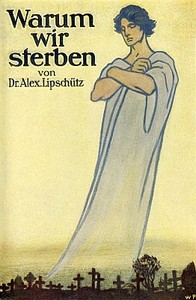
Warum wir sterben by Alejandro Lipschütz
Alejandro Lipschütz's Warum wir sterben is a deep exploration of a simple question: Why must living things die? He doesn't settle for easy answers. Instead, he builds his case by looking at the incredible diversity of life. He points out creatures like hydra or certain bacteria that don't seem to age in the traditional sense. If they can avoid it, he asks, why can't we? The book walks through the mechanics of cells, reproduction, and evolution, arguing that for complex organisms like us, death isn't just an accident—it might be a programmed, useful part of life's grand scheme, making room for new generations and adaptation.
Why You Should Read It
This book changed how I think about getting older. It's not morbid; it's curiously liberating. Lipschütz writes with a sense of wonder that's contagious. He connects big biological ideas to the human experience in a way that feels personal. You start seeing aging not as a failure, but as a fascinating, intricate process shaped by billions of years of evolution. It gives you a new framework to think about life, medicine, and what it means to be a temporary part of a much longer story.
Final Verdict
Perfect for curious minds who enjoy popular science but want to go deeper than a magazine article. If you've ever read something by Carl Sagan or Stephen Jay Gould and loved the big-picture thinking, you'll find a kindred spirit in Lipschütz. It's for readers who aren't afraid of complex ideas but appreciate them delivered with clarity and a genuine sense of awe. A truly thought-provoking read that stays with you.
This work has been identified as being free of known copyright restrictions. Feel free to use it for personal or commercial purposes.
Kenneth Walker
1 year agoI came across this while browsing and it challenges the reader's perspective in an intellectual way. Absolutely essential reading.
Paul Wright
7 months agoVery helpful, thanks.
William Perez
1 year agoThanks for the recommendation.
Dorothy Young
1 year agoI started reading out of curiosity and the flow of the text seems very fluid. This story will stay with me.



Richard Miller
7 months agoWow.