1

A Hoosier holiday — Key Ideas to Explore
2
0
Project Gutenberg
2023
New York (State) -- Description and travel; Pennsylvania -- Description and travel; Ohio -- Description and travel; Dreiser, Theodore, 1871-1945 -- Travel; Booth, Franklin, 1874-1948 -- Travel; Indiana -- Description and travel
Readers of public-domain and historical texts
Project Gutenberg digital edition
en
Edition facts
Words: 174,860
Reading time: 761 min
Text sections: 64
Source:
Project Gutenberg record #70269
Theodore Dreiser's 1916 travelogue recounts an automobile journey from New York to Indiana, blending road observations with nostalgic reflections on his Midwestern childhood. Illustrated by Franklin Booth, the narrative contrasts Eastern commercialism with the drowsy, speculative atmosphere of the Middle West.
Editorial Edition Score
4.9/5
★★★★★
★★★★★
Calculated from edition completeness, EPUB availability, text structure and catalogue metadata. Not a user rating.
Edition quality
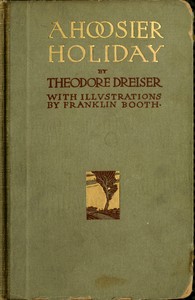
Theodore Dreiser's A Hoosier Holiday (1916) is a travel narrative that follows an automobile journey from New York City to Warsaw, Indiana, the author's childhood home. The book is illustrated by Franklin Booth, who accompanied Dreiser on the trip. Rather than a straightforward itinerary, the text weaves together descriptions of landscapes, towns, and people with digressions on memory, art, and the American character. Dreiser's voice is consistently reflective, often pausing to contrast the bustling, commercial East with the slower, more dreamy atmosphere he finds in the Middle West.
The Journey as a Reel of Memory
Dreiser frames the trip as a chance to "unreel like a film" his past, a metaphor that recurs in his descriptions of towns and roads. In the excerpt, he wishes he could "unreel like a film, and then represent one's life to oneself." This cinematic language suggests that the physical journey triggers a mental rewind, where he imagines editing out certain incidents and extending others. The automobile itself becomes a device for this temporal movement: it allows the party to "seek ideal nooks and secluded places" at will, but also to speed through landscapes that evoke earlier decades. Dreiser's longing to "go back" is not merely nostalgic; it is a structural principle that organizes the narrative, as each new town prompts a comparison with the past.
Contrasting East and West
Throughout the excerpts, Dreiser draws a sharp contrast between the commercial East and the drowsy Middle West. He notes that in towns like Napoleon, Defiance, and Hicksville, "that definite commercial sense which was so marked in places farther East was not here abounding." Instead, he finds a "nebulous, speculative, dreamy" temperament, a region "outside the keen, shrill whip of things." This opposition is not merely geographic but moral: Dreiser explicitly states, "I hate greedy, commercial people." The landscape itself reflects this difference: the Maumee River and its parallel canal are described as "simple and yet so beautiful," evoking the pastoral poetry of Goldsmith and Gray. The heat and stillness of the Indiana summer become emblems of a slower, more contemplative life.
The Role of Franklin Booth's Illustrations
Franklin Booth's illustrations are an integral part of the book, as indicated by the title page and frontispiece. The text occasionally references Booth's presence, as when Dreiser says, "I said to Franklin, and he will bear witness to it." Booth is not merely a passive observer; he buys a rubber ball in Napoleon, and the two stop to play with it in a field. This detail underscores the improvisational, leisurely quality of the trip. The illustrations likely complement Dreiser's verbal sketches of small towns and rural scenes, though the excerpts do not describe specific images. The collaboration between writer and artist suggests a shared sensibility, one that values the picturesque and the idyllic over the industrial or the urban.
Readers approaching A Hoosier Holiday should expect a meandering narrative that prioritizes mood and reflection over strict chronology. Dreiser's prose is dense with observation, but his true subject is the tension between the present journey and the remembered past. The book rewards those who read slowly, attending to the shifts between external description and internal reverie. Booth's illustrations, though not reproduced here, are best imagined as visual counterparts to Dreiser's verbal landscapes.
Reader reflection
Your personal reading reflection
Build a private reading journal entry for this title.
Your progress
0
/
10
2
What was your overall reaction to the book?
3
Would you recommend this book to another reader?
4
What was the reading difficulty like?
5
Did the book meet your expectations?
6
What did you appreciate most?
7
Would a second reading be valuable?
8
Would this book work well in a reading group?
9
Which lesson or insight stayed with you?
10