1

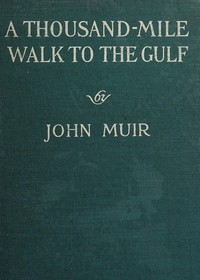
A Thousand-Mile Walk to the Gulf — Edition Insights
2
0
Project Gutenberg
2019
California -- Description and travel; Naturalists -- United States -- Biography; Cuba -- Description and travel; Southern States -- Description and travel; Walking -- United States; Muir, John, 1838-1914 -- Diaries; Muir, John, 1838-1914 -- Travel -- Southern States; Plants -- Southern States; Natural history -- Southern States; Natural history -- Cuba
Readers of public-domain and historical texts
Project Gutenberg digital edition
en
Edition facts
Words: 43,991
Reading time: 192 min
Text sections: 11
Source:
Project Gutenberg record #60749
An editorial note examining John Muir's authorial choices in diction, dialogue, and description during his 1867 walk from Kentucky to Florida and Cuba, based on his journal entries.
Editorial Edition Score
4.8/5
★★★★★
★★★★★
Calculated from edition completeness, EPUB availability, text structure and catalogue metadata. Not a user rating.
Edition quality
John Muir's A Thousand-Mile Walk to the Gulf is a record of his 1867 journey from Kentucky to Florida and Cuba, drawn directly from his field notebooks. The text reveals a naturalist who observes with scientific precision and a writer who shapes his observations through deliberate diction, dialogue, and description. Muir's prose oscillates between lyrical appreciation of landscapes and blunt, sometimes unsettling, depictions of human encounters. His editor, William Frederic Badè, notes that Muir inscribed his notebook with the address "John Muir, Earth-planet, Universe," signaling the author's self-conception as a citizen of the natural world rather than a regional traveler.
Diction: The Naturalist's Vocabulary
Muir's word choices reflect his dual role as scientist and wanderer. He describes a cactus as "treelike" and a magnolia's leaf as "endowed with superb richness of color and form," blending taxonomic accuracy with aesthetic appreciation. His diction often personifies plants and landscapes: a flower's glance "may at times control the greatest of creation's braggart lords." This anthropomorphism extends to his critique of fenced fields, which he calls "cages" for plants. Muir's vocabulary is precise yet evocative, avoiding technical jargon in favor of accessible imagery. He notes limestone, flint, coral, and shells as geological markers, but frames them as part of a living narrative. His language occasionally sharpens into moral commentary, as when he observes that a negro child lying naked in ashes is "not quite in harmony with Nature," a statement that reveals his complex views on human society.
Dialogue: Encountering the Human South
Muir records dialogue sparingly, but each instance carries weight. When a man asks if he is armed, Muir replies, "I said no," and the man "quailed, stepped aside, and allowed me to pass, for fear of being shot." The exchange is terse, yet it conveys the tension of post-Civil War travel. In a more extended scene, Muir approaches a campfire where a woman coaxes her child to eat with the words, "Come, honey, eat yo’ hominy." Muir transcribes the dialect phonetically, marking the speech as foreign to his ear. He then describes the child as "naked as to the earth he came," a phrase that echoes biblical creation. These dialogues are not mere color; they serve as windows into the social landscape Muir traverses, highlighting racial and cultural differences that he observes but does not fully analyze.
Description: The Art of the Set Piece
Muir's descriptive passages are carefully composed set pieces. The campfire scene at night is a prime example: he describes the "big, glowing log fire" illuminating leaves and sprays "with more than noonday distinctness," while the surrounding woods become "still darker." The two negroes sit in the center of this "globe of light," their skin "flashing off light as if made of glass." Muir's description is cinematic, using contrast and hyperbole to create a vivid tableau. He compares the couple to "twin devils" seen anywhere but the South, then immediately corrects the impression. This technique of building a startling image and then qualifying it is characteristic of Muir's descriptive strategy. He also uses simile and metaphor to link the unfamiliar to the known, as when he compares the child to Adam "manufactured ... direct from the earth."
Structure: The Journal as Literary Form
The book's structure follows Muir's chronological journey, with chapter headings like "Kentucky Forests and Caves" and "Camping among the Tombs." Within each chapter, entries are dated (e.g., "October 19"), preserving the diary format. This structure allows Muir to shift between modes: botanical notes, travelogue, and personal reflection. The editor's introduction frames the work as a "botanical excursion," but the text itself includes dramatic encounters and philosophical asides. Muir's habit of sleeping without blankets and foraging for bread is presented as discipline, not hardship. The journey's endpoint—California's Twenty Hill Hollow—is introduced only in the final chapter, suggesting that the walk itself, not the destination, is the subject. The journal form gives the narrative an episodic quality, with each day offering new observations and challenges.
Readers approaching A Thousand-Mile Walk to the Gulf should attend to Muir's authorial choices as much as his natural history. His diction, dialogue, and description are not transparent records but crafted representations of his experience. The journal form invites us to read between the dated entries, noting what Muir chooses to include and what he omits. This edition, edited by William Frederic Badè, preserves the raw material of a naturalist's mind in motion—a mind that saw itself as belonging to the entire planet.
Reader reflection
Your personal reading reflection
Build a private reading journal entry for this title.
Your progress
0
/
10
2
How did the book work for you overall?
3
Would you pass this book on to a friend?
4
How easy was the book to follow?
5
How original did the book feel?
6
Did any part of the book feel personally relevant?
7
Do you expect to return to this book?
8
How did the pace of the book feel?
9
What changed or sharpened your thinking?
10