1

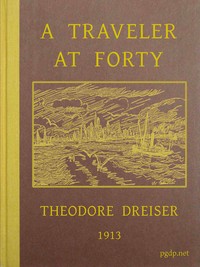
A Traveler at Forty — Context and Discussion
27
14
Project Gutenberg
2021
Europe -- Description and travel; Dreiser, Theodore, 1871-1945 -- Travel -- Europe; Americans -- Europe -- History -- 20th century
Readers of public-domain and historical texts
Project Gutenberg digital edition
en
Edition facts
Words: 166,669
Reading time: 725 min
Text sections: 57
Source:
Project Gutenberg record #65765
Theodore Dreiser's 1913 travelogue records his first European tour at age forty, blending sharp observations of people, places, and social rituals with a novelist's eye for detail and a frank, often skeptical personal voice.
Editorial Edition Score
4.9/5
★★★★★
★★★★★
Calculated from edition completeness, EPUB availability, text structure and catalogue metadata. Not a user rating.
Edition quality
Theodore Dreiser was forty years old and already a celebrated novelist when he made his first trip to Europe in 1912. A Traveler at Forty is the resulting record—not a polished guidebook but a sprawling, diary-like narrative that captures the author's unfiltered reactions to people, landscapes, and customs. Dreiser's prose is characteristically direct, often skeptical, and attentive to the economic realities behind picturesque scenes. The book's structure follows his itinerary from England through France, Italy, Switzerland, Germany, and Holland, but its real subject is the collision between Dreiser's American sensibility and the layered history of Europe.
A Novelist's Gaze on Travel
Dreiser approaches Europe as a novelist, not a tourist. His descriptions linger on social types, economic transactions, and the subtle hierarchies of class. In Monte Carlo, he records the exact denominations of chips and banknotes at the roulette table—"small piles of gold louis, stacks of eight, ten, fifteen and even twenty-five franc pieces"—and notes the mechanical efficiency of the croupiers. This attention to material detail is typical: Dreiser treats a casino as a system of human behavior, not merely a backdrop. He also observes his traveling companions with a novelist's detachment, noting Barfleur's geniality and Scorp's stoic gambling style. The narrative voice is consistently curious but never starry-eyed; Dreiser is as interested in the cost of things as in their beauty.
The Texture of Everyday Europe
Dreiser's Europe is a place of specific, tangible experiences: the "glittering white world" outside the Monte Carlo casino, the "cream-colored buildings and waving palms" of the Riviera, the "pale crisp bank-notes" on gaming tables. He records sensory details—the bright sun after the dim casino, the "haut parisiennes" atmosphere of flower shops—that ground abstract impressions in physical reality. His descriptions of London, Paris, and Rome are similarly concrete, focusing on streets, buildings, and the flow of daily life rather than on famous monuments. The book's 57 chapters move at a deliberate pace, allowing Dreiser to pause for extended reflections on a single scene, such as the gambling sequence that occupies several pages.
Voice and Self-Presentation
Dreiser's narrative voice is frank, sometimes self-deprecating, and unafraid to admit ignorance. At the roulette table, he confesses he "did not understand at first" the mechanism of the wheel or the duties of the croupiers. He describes his own excitement and disappointment with equal candor: after winning a few louis, he imagines staying in Europe for a year; after losing, he wonders if he is "such a fortunate player after all." This honesty extends to his portrayal of others. He notes Barfleur's superstition about sending money to his mother "for luck" and Scorp's impassive gambling style. Dreiser does not present himself as a seasoned traveler but as a curious, sometimes naive observer, which gives the narrative an engaging immediacy.
Structure and Selection
The book's organization is chronological but not rigidly thematic. Dreiser moves from England to France, Italy, Switzerland, Germany, and Holland, with a return to Paris before sailing home. Each chapter focuses on a single location or episode, such as "A Night Ramble in Florence" or "The Night-Life of Berlin." The chapter titles suggest a mix of planned sightseeing and spontaneous encounters. Dreiser includes encounters with fellow travelers, local guides, and strangers, and he does not shy away from reporting his own mistakes or disappointments. The narrative is less a systematic survey than a personal record, shaped by Dreiser's interests and moods. This selectivity gives the book a distinctive, idiosyncratic character, as the reader follows not a tour itinerary but a novelist's wandering attention.
Readers approaching A Traveler at Forty should expect a leisurely, digressive narrative that rewards patience. Dreiser's prose is dense with observation, and his willingness to record both the impressive and the mundane makes the book a valuable document of early twentieth-century travel. The illustrations by William Glackens, a noted artist and Dreiser's contemporary, complement the text with visual impressions. This edition reproduces the original 1913 Century Company publication, including Glackens's drawings and the author's chapter headings.
Reader reflection
Your personal reading reflection
Build a private reading journal entry for this title.
Your progress
0
/
10
2
How much did you enjoy the reading experience?
3
Would you pass this book on to a friend?
4
How easy was the book to follow?
5
Did it raise ideas you would like to talk about?
6
Did anything about the book feel genuinely new?
7
How would you describe its reading pace?
8
How understandable was the text?
9
In one sentence, what did you learn?
10