1

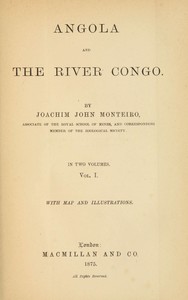
Angola and the River Congo, vol. 1 — Themes and Context
17
8
Project Gutenberg
2022
Angola -- Description and travel; Congo River -- Description and travel; Monteiro, Joachim John -- Travel -- Angola; Angola -- Social life and customs -- 19th century
Readers of public-domain and historical texts
Project Gutenberg digital edition
en
Edition facts
Words: 67,454
Reading time: 294 min
Text sections: 17
Source:
Project Gutenberg record #68110
Joachim John Monteiro's 1875 travelogue blends mineralogical expertise with vivid, unsparing observations of Angola's landscapes, peoples, and logistics. The narrative voice shifts from detached scientific cataloging to personal, almost comic accounts of hardship, such as mosquito plagues and hammock travel, revealing the author's dual identity as a mining engineer and a husband traveling with his wife.
Editorial Edition Score
4.8/5
★★★★★
★★★★★
Calculated from edition completeness, EPUB availability, text structure and catalogue metadata. Not a user rating.
Edition quality
Joachim John Monteiro, an associate of the Royal School of Mines, structures his account of Angola and the Congo River around a tension between systematic description and personal anecdote. The preface promises an “accurate and truthful account” of the region’s “striking features and productions,” yet the narrative frequently breaks from this scientific posture into moments of wry, embodied experience. One of the most telling shifts occurs in the extended passage on mosquitoes, where Monteiro moves from classifying species by color and behavior to recounting a sleepless night in a grass barracoon, his men “killing mosquitoes on their hands and faces all night long.” This oscillation between detached observer and beleaguered traveler defines the work’s distinctive voice.
A Mineralogist’s Eye, a Traveler’s Body
Monteiro’s training as a mining engineer surfaces in his precise attention to geological and botanical detail. He notes the “silky fibre in the seed-pod of the ‘Mafumeira’” and the use of “isca,” a brown down from palm stems, for padding carriers’ loads. Yet this cataloging is repeatedly undercut by physical discomfort. The description of hammock travel—the “hard, wearying work” of bearers who “run with one all day, in the hot sun, nearly naked”—is rendered with a mixture of admiration and clinical detachment. Monteiro’s voice shifts from that of a naturalist to a man counting carriers: “to take my wife, myself, a tent… we had to engage exactly thirty carriers.” The precision of the number underscores the logistical reality behind the scientific expedition.
The Mosquito as Narrative Disruptor
No passage better illustrates Monteiro’s change in pace than his treatment of mosquitoes. He begins taxonomically, distinguishing the “light brown” marsh mosquito from the “little black shiny fellow” near running water, and notes a “beautifully striped or banded” species. But the tone shifts abruptly when he recalls his first night at Quingombe: “a hum like that of distant bees was heard, and a white mist seemed to rise… which was nothing less than a cloud of mosquitoes.” The scientific observer becomes a sufferer, his men “unprovided with mosquito nets” and “sleep was perfectly out of the question.” Monteiro’s own mosquito bar protects him from bites but not from “sand-fleas,” leaving him “feverish.” The episode ends with the party laughing at “our haggard appearance,” a rare note of shared human vulnerability that punctures the book’s authoritative surface.
Pace and the Logistics of Exploration
Monteiro’s narrative rhythm is governed by the practicalities of movement. The journey from Quincollo to Quingombe is described in a single sentence, but the preparations for it occupy a paragraph: the list of carriers, the “Madeira cane chair” for crossing streams, the “Jack Wash” with his soap and irons. This attention to logistics slows the narrative, forcing the reader to dwell on the material conditions of travel. Conversely, moments of crisis—like the mosquito night—accelerate the prose into vivid, almost novelistic detail. The effect is a work that feels less like a continuous travelogue than a series of set pieces, each with its own tempo. Monteiro’s voice, whether cataloging malachite deposits or recounting sleepless nights, remains consistently precise, but the pace varies with the intensity of his personal engagement.
Monteiro’s account rewards readers who attend to its shifts in register. The scientific passages gain texture when read alongside the personal ones; the mosquito episode, for instance, is more striking for following a dry enumeration of species. The book’s structure—alternating between general description and specific anecdote—invites a nonlinear reading. Those interested in the author’s voice might begin with the hammock or mosquito sections, then move to the mineralogical chapters to see how the same man writes when his body is not under duress.
Reader reflection
How did this book work for you?
Your answers remain private and are stored only in this browser.
Your progress
0
/
10
2
What was your overall reaction to the book?
3
Would you recommend this book to another reader?
4
How much effort did this book require?
5
How did the reading compare with what you expected?
6
How personally connected did you feel to the book?
7
How useful did the reading feel?
8
Do you expect to return to this book?
9
What did this book teach you most?
10