1

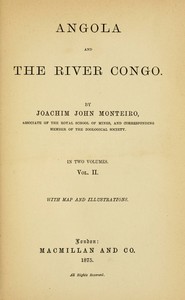
Angola and the River Congo, vol. 2 — Key Ideas to Explore
2
0
Project Gutenberg
2022
Angola -- Description and travel; Congo River -- Description and travel; Monteiro, Joachim John -- Travel -- Angola; Angola -- Social life and customs -- 19th century
Readers of public-domain and historical texts
Project Gutenberg digital edition
en
Edition facts
Words: 70,479
Reading time: 307 min
Text sections: 17
Source:
Project Gutenberg record #68176
Monteiro's second volume details his travels in Angola and along the Congo River, blending geological observations with accounts of colonial administration, slave trade remnants, and local customs. The narrative shifts between scientific description and personal anecdotes, revealing tensions between European enterprise and African realities.
Editorial Edition Score
4.8/5
★★★★★
★★★★★
Calculated from edition completeness, EPUB availability, text structure and catalogue metadata. Not a user rating.
Edition quality
Monteiro opens this volume with a precise geographical description of the sixty-mile stretch from Ambriz to Loanda, noting that the region called Mossulo is "inhabited by a t"—the text cuts off, but the pattern of blending topography with human habitation is set. Throughout, he alternates between the eye of a mining engineer and the ear of a social observer, recording both the bitumen deposits near Libongo and the "wretched pay of officials" in Loanda. The book's structure follows a southward journey, each chapter anchored to a place name, yet the narrative repeatedly breaks from itinerary into set-piece encounters: a failed copper-prospecting expedition that leaves the party "more dead than alive," or the sight of a town whose "large walled gardens" still bear the imprint of the slave trade.
Geological Curiosity and Practical Hardship
Monteiro's professional training as an Associate of the Royal School of Mines surfaces in his attention to copper deposits, bitumen seeps, and volcanic rocks. But the pursuit of mineral samples repeatedly collides with the difficulties of travel. In one extended episode, he and an old Portuguese companion set out at daybreak for a copper locality, guided by a native who misleads them. They carry only "half a dozen biscuits and a tin of jam," expecting to return by noon. Instead, they wander until evening, reach the site the next day at noon, and then rush back fasting to the Catumbella River, where they "rush to the water's edge to drink." The anecdote illustrates a recurring pattern: the author's scientific aims are constantly mediated by unreliable guides, scarce provisions, and the physical toll of the terrain. The copper ore they eventually extract amounts to "about half a ton of very good quality," but no more is found—a microcosm of the region's tantalizing but elusive mineral wealth.
The Town as Palimpsest of Slave-Trade Legacies
Benguella is described as "large, consisting of good houses and stores, irregularly distributed over several fine squares and roads." Monteiro notes that the "custom of the houses having large walled gardens and enclosures for slaves, in former times, stamping it with a wide straggling character." The physical layout of the town thus preserves a history Monteiro does not need to narrate at length: the slave trade is present as an architectural echo. He adds that during the slave-trade era Benguella was "one of the principal shipping ports of Angola, many thousands of slaves being sent off from it to the Brazils and Cuba," and that the "last two or three shipments took place whilst I was working the cop"—the sentence breaks off, but the implication is clear. The present tense of the narrative coexists with a recent past of human trafficking, and Monteiro's matter-of-fact tone does not diminish the weight of that juxtaposition.
Voice and the Limits of European Knowledge
Monteiro writes as a participant-observer who is both inside and outside the colonial system. He criticizes "the usual incubus of the custom-house, with its high duties and vexations weighing heavily on all enterprise and commerce," yet he also relies on the infrastructure of Portuguese administration and on African intermediaries. His narrative voice is often wryly self-deprecating about his own misadventures—the copper expedition is told with a dry humor that undercuts any heroic pretension. At the same time, he records native practices (such as the use of wild-hemp smoking or native remedies for ulcers) without moralizing, though he does not grant them the same analytical space he gives to geology or trade. The excerpts suggest a text that is aware of its own partial perspective: Monteiro knows he is a foreigner moving through a landscape he cannot fully control or comprehend, and that awareness shapes the book's tone.
Readers should attend to the gaps and abrupt transitions in the text—the broken sentences, the episodes that trail off, the moments when Monteiro's scientific detachment gives way to physical exhaustion or surprise. These are not flaws but signals of the friction between European expectations and African conditions. The volume rewards those who read for the incidental detail: the taste of a tin of jam shared on a failed expedition, the shape of a walled garden that outlives the trade it once served, the half-ton of copper ore that is both a discovery and a dead end.
Reader reflection
How did this book work for you?
Your answers remain private and are stored only in this browser.
Your progress
0
/
10
2
Was reading this book enjoyable?
3
Is this a title you would suggest to others?
4
How much effort did this book require?
5
What was its emotional impact?
6
How original did the book feel?
7
Do you expect to return to this book?
8
Could you follow the author’s main argument?
9
What is the main idea you are taking away?
10