1

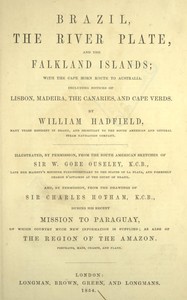
Brazil, the River Plate, and the Falkland Islands With the Cape Horn route to Australia. Including notices of Lisbon, Madeira, the Canaries, and Cape Verde. — Key Ideas to Explore
2
0
Project Gutenberg
2018
Brazil -- Description and travel; Falkland Islands; Buenos Aires (Argentina) -- Description and travel; Brazil -- Economic conditions; Montevideo (Uruguay) -- Description and travel; Paraguay -- Description and travel
Readers of public-domain and historical texts
Project Gutenberg digital edition
en
Edition facts
Words: 163,143
Reading time: 710 min
Text sections: 22
Source:
Project Gutenberg record #56402
William Hadfield's 1854 travelogue blends commercial intelligence with sharp observations of South American cities, dictators, and British misadventures, illustrated by diplomats' sketches.
Editorial Edition Score
4.9/5
★★★★★
★★★★★
Calculated from edition completeness, EPUB availability, text structure and catalogue metadata. Not a user rating.
Edition quality
William Hadfield, secretary to the South American and General Steam Navigation Company, wrote this 1854 volume not as a neutral travel account but as a commercial and strategic brief. The title page announces illustrations from diplomats Sir W. Gore Ouseley and Sir Charles Hotham, whose official posts in Brazil and Paraguay lend the book a quasi-governmental authority. Hadfield’s preface frames the work around steam navigation needs, Liverpool’s exclusion from routes, and the potential of screw propulsion—a concrete, industry-specific agenda that shapes his descriptions of ports and rivers.
Commercial Imperatives and Steam Routes
The preface and introduction foreground steam navigation as the book’s raison d’être. Hadfield details how Anglo–South American commerce was served before 1850, the inadequacy of those means, and Liverpool’s exclusion from the new lines. He notes the “paddle pioneer of the ocean fleet to the Plate” and calculates “fifteen thousand miles of steaming” with his own notes. This is not a tourist’s itinerary but a businessman’s assessment of infrastructure gaps. The catalog subject “Brazil – Economic conditions” aligns with this emphasis, but the excerpts show that economic commentary is tightly bound to shipping logistics rather than abstract analysis. Hadfield’s voice is that of a company secretary advocating for better connections, not an impartial observer.
Urban Landscapes and Political Judgments
In Buenos Aires, Hadfield describes the central square as “the scene of many important political changes” and recounts the 1806 British invasion under General Whitelock, calling the tactics “error and folly.” He contrasts the city’s extension despite “civil wars and bad government” with the dictator Rosas’s failure to leave an “enduring personal impress.” The description of Rosas’s country house Palermo—built on a swampy bank, “at times several feet under water”—is pointedly critical. These passages blend topography with political commentary, a pattern repeated in other cities. The catalog subjects “Buenos Aires (Argentina) – Description and travel” and “Montevideo (Uruguay) – Description and travel” are present, but the excerpts reveal that description is never neutral; it is always weighed against governance and commercial potential.
Illustrations as Diplomatic Credentials
The title page prominently credits Sir W. Gore Ouseley, former British minister to the La Plata states, and Sir Charles Hotham, who recently returned from a mission to Paraguay. Their sketches are used “by permission,” implying official access. This framing elevates the book above ordinary travel writing: it claims insider knowledge from men who moved in diplomatic circles. The catalog does not list “illustrations” as a subject, but the visual component is integral to the work’s authority. Hadfield’s text itself occasionally reads like a gloss on these images, though the excerpts do not describe specific plates. Readers should attend to how the illustrations and text together construct a view of South America filtered through British imperial and commercial interests.
This is a book with a double purpose: to inform British merchants and to justify steam navigation investments. Hadfield’s prose is opinionated, his judgments sharp, and his commercial lens unapologetic. Readers interested in mid-nineteenth-century British attitudes toward South America, or in the practical challenges of early steam travel, will find the text rewarding. Approach it as a primary source for economic history and colonial discourse rather than as a neutral guide.
Reader reflection
Your personal reading reflection
Build a private reading journal entry for this title.
Your progress
0
/
10
2
What was your overall reaction to the book?
3
How likely are you to recommend this book?
4
How much effort did this book require?
5
Was the book what you thought it would be?
6
What was the strongest part of the book?
7
Would you start a conversation about this book?
8
Was the book moving at the right speed?
9
What did this book teach you most?
10