1

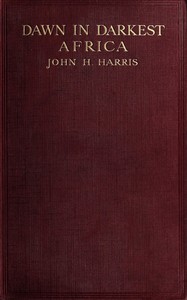
Dawn in darkest Africa — A Reader’s Guide
25
14
Project Gutenberg
2023
Africa, West -- Description and travel; Ethnology -- Africa, West; Slavery -- Africa, West; Africa, West
Readers of public-domain and historical texts
Project Gutenberg digital edition
en
Edition facts
Words: 87,835
Reading time: 382 min
Text sections: 35
Source:
Project Gutenberg record #69757
John H. Harris's 1912 study of West Africa examines colonial labor policies, slavery, and ethnography through a humanitarian lens, with an introduction by the Earl of Cromer. The narrative shifts between policy analysis and anecdotal evidence, revealing tensions between official rhetoric and on-the-ground practices.
Editorial Edition Score
4.9/5
★★★★★
★★★★★
Calculated from edition completeness, EPUB availability, text structure and catalogue metadata. Not a user rating.
Edition quality
John H. Harris opens Dawn in Darkest Africa with a frontispiece portrait of Mushamalengi, a Bakuba prince, immediately signaling the work's dual focus on individual African lives and broader colonial systems. The book, introduced by the Earl of Cromer, positions itself as a humanitarian critique of European administration in West Africa, particularly the Congo. Harris's prose moves between detached policy analysis and vivid, often damning anecdotes—such as a British official seizing church congregations for carrier duty—creating a rhythm that juxtaposes systemic critique with visceral human impact.
The Earl of Cromer's Cautious Endorsement
The introduction by the Earl of Cromer establishes a key tension in the book's voice. Cromer acknowledges a common skepticism toward missionary and philanthropic sources, noting that 'occasional errors, the result of unchecked enthusiasm in a noble cause' must be weighed against their benefits. He cites the Congo administration as a 'disgrace to civilized Europe' and draws a startling comparison: the population loss under Congo rule rivals that of the Mahdi's Sudan, where over 75 percent of inhabitants perished. Cromer's measured tone—advocating for 'practical methods' consonant with imperial interests—frames Harris's subsequent evidence as both necessary and subject to scrutiny.
Forced Labor and the Language of Public Utility
Harris's central argument hinges on the phrase 'works of public utility,' which he calls 'a blessed phrase that covers a multitude of questionable necessities.' He methodically catalogs corvée regulations across British, German, French, and Portuguese territories: in the Gambia, able-bodied males face fines or imprisonment for refusing road labor; in Southern Nigeria, both men and women between 15 and 40 can be called up for six days per quarter. Harris contrasts these European-imposed systems with traditional chiefly exactions, which were 'always made at a time which avoids interference with agricultural necessities' and kept labour close to villages. The shift from customary to colonial forced labour, he argues, erases these safeguards.
Anecdote as Evidence: The Sunday Church Raid
Among Harris's most striking pieces of evidence is a 1909 incident in Southern Nigeria: a British official, impatient for carriers on a Sunday morning, 'marched into the two nearest churches and seized the congregations, including the native minister,' then forced the clergyman to carry a whisky box. Harris notes that local missionaries had instilled 'a deep reverence of all things pertaining to worship,' making the official's conduct especially damaging. The anecdote exemplifies Harris's method—using a specific, almost absurd detail to illuminate systemic abuse. He acknowledges the 'ludicrous' aspect at a distance, but insists on the local gravity, a rhetorical move that recurs throughout the book.
Harris's narrative voice oscillates between the analytical and the anecdotal, a technique that keeps the reader alert to both policy and its human cost. Readers should attend to how he deploys official documents alongside personal accounts, and how the Earl of Cromer's introduction sets up a framework of cautious credibility. The book rewards attention to its structural shifts—from broad comparative surveys to sharp, localized stories—as these reveal Harris's strategy for making a humanitarian case without relying solely on moral appeal.
Reader reflection
What did you think of this book?
Answer a few questions and save a private reflection on this device.
Your progress
0
/
10
2
Was reading this book enjoyable?
3
How likely are you to recommend this book?
4
How demanding did the text feel?
5
Was the book moving at the right speed?
6
Could you see yourself revisiting this book?
7
Did the book give you something worth debating?
8
Was the book easy to understand?
9
What did this book teach you most?
10