1

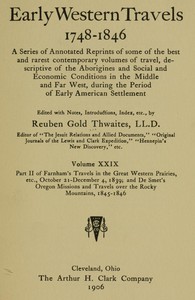
Farnham's Travels in the Great Western Prairies, etc., part 2, October 21-December 4, 1839 and De Smet's Oregon Missions and Travels over the Rocky Mountains — Story, Setting & Ideas
14
9
Project Gutenberg
2022
West (U.S.) -- Description and travel; Overland journeys to the Pacific; Oregon -- Description and travel; West (U.S.) -- History -- To 1848; Rocky Mountains -- Description and travel; Indians of North America -- West (U.S.)
Readers of public-domain and historical texts
Project Gutenberg digital edition
en
Edition facts
Words: 127,387
Reading time: 554 min
Text sections: 25
Source:
Project Gutenberg record #67730
Two firsthand accounts of the 1830s-40s Oregon Country: Farnham's journey from Vancouver to the Willamette settlements and De Smet's missionary travels among Flathead, Kalispel, and Kettle Fall tribes, with vivid descriptions of landscapes, river dangers, and early Catholic missions.
Editorial Edition Score
4.9/5
★★★★★
★★★★★
Calculated from edition completeness, EPUB availability, text structure and catalogue metadata. Not a user rating.
Edition quality
This volume pairs two distinct narratives of the Oregon Country separated by a few years but linked by a shared landscape and the presence of Native peoples. Thomas Jefferson Farnham's account, covering October to December 1839, traces his movements from Vancouver to the Willamette Valley and back, offering observations on settlers, missions, and the region's geography. Pierre-Jean de Smet's journal, spanning 1845-1846, details his missionary journeys through the Rocky Mountains, focusing on the Flathead, Kalispel, and Kettle Fall tribes. Both authors write as outsiders—Farnham a traveler and lawyer, De Smet a Jesuit priest—yet their reports reveal contrasting priorities: Farnham notes economic and agricultural potential, while De Smet emphasizes spiritual encounters and the building of churches. The excerpts show De Smet's dramatic river rescue at the Dalles and his astonishment at a small frame church built by newly baptized Kettle Fall Indians.
Two Voices, One Territory
Farnham and De Smet occupy the same geographic space but write from different vantage points. Farnham's prose is that of a secular observer: he notes the Willamette's falls, the cabins of settlers like Mr. Johnson and Thomas McKay, and the operations of the Methodist Episcopal Mission. His catalog of rivers, soils, and climate reads like a report for potential emigrants. De Smet, by contrast, frames his travels through a religious lens. He describes baptisms, the building of a church by the Shuyelphi (Kettle Fall) people, and the arrival of Father Nobili. Where Farnham sees resources, De Smet sees souls. The editor, Reuben Gold Thwaites, juxtaposes these accounts without commentary, allowing the reader to measure the distance between a lawyer's survey and a missionary's chronicle.
Peril on the Columbia
De Smet's account of the Dalles passage is the volume's most dramatic episode. He writes that he left his barge to walk, warning the young boatman against the attempt. A whirlpool seized the boat, drawing it into an abyss; De Smet, kneeling on an overhanging rock with Indians, prayed. The whirlpool then "reluctantly yielded up the prey." The language is charged with divine intervention—the boatmen were saved by what De Smet calls the aid of Heaven. This scene contrasts with Farnham's more matter-of-fact descriptions of river travel. Farnham mentions the Columbia's descent and the dangers of the bar at Astoria, but his tone remains that of a geographer. De Smet's near-tragedy personalizes the landscape, turning a geographic feature into a site of spiritual trial.
Missions and Maps
De Smet's narrative is punctuated by geographical details that double as mission records. He notes the Flathead Lake, Clark's Fork, and the St. Mary's River, but also reports that the Flatheads are the "chief residence" of the tribe he serves. The Kettle Fall nation, he writes with surprise, built a small frame church—their "first attempt at architecture." This detail reveals the agency of Native converts, a counterpoint to the usual narrative of passive reception. Farnham's geography is more abstract: he describes the Willamette's mouth, the mountains, and the falls, but his human geography is limited to white settlers and missionaries. Together, the two accounts show a region being mapped both by surveyors and by the spread of missions, with Native peoples as both guides and converts.
Readers should note that these texts are part of Thwaites's larger series Early Western Travels, which reprints rare volumes with scholarly apparatus. The excerpts here are incomplete—Farnham's narrative is only the second part of his travels, and De Smet's is a single mission report. Neither author provides a full picture of the Oregon Country; rather, they offer partial, situated views. Comparing their accounts reveals how the same region could be simultaneously a field for settlement and a field for evangelism, and how Native peoples appear in both as subjects of observation and as agents of their own history.
Reader reflection
How will you remember this book?
Save your reaction, strongest insight, and memorable passage.
Your progress
0
/
10
2
Did this book hold your interest?
3
Is this a title you would suggest to others?
4
Did the language feel accessible?
5
Did the book give you something worth debating?
6
How much did the book move you?
7
Did anything about the book feel genuinely new?
8
Which element worked best for you?
9
What did this book teach you most?
10