1

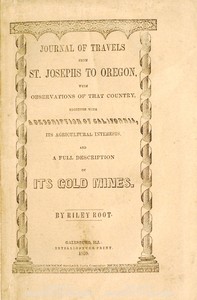
Journal of Travels From St. Josephs to Oregon With Observations of That Country, Together With Some Description of California, Its Agricultural Interests, and a Full — Themes and Context
8
6
Project Gutenberg
2020
California -- Description and travel; Overland journeys to the Pacific; Oregon -- Description and travel; California -- Gold discoveries; Oregon Territory -- History
Readers of public-domain and historical texts
Project Gutenberg digital edition
en
Edition facts
Words: 52,595
Reading time: 229 min
Text sections: 7
Source:
Project Gutenberg record #62155
Riley Root's 1850 journal combines a travel narrative from Illinois to Oregon with a detailed account of California's gold mines, notable for its experimental punctuation and firsthand observations of the Whitman massacre.
Riley Root's 1850 journal opens with a distinctive explanatory note announcing a new method of punctuation that discards colons and semicolons entirely. This typographical experiment immediately signals that the work is as much a curiosity of form as it is a travel record. The text that follows is a hybrid: part overland journey diary, part agricultural and mineral survey of Oregon and California, and part eyewitness account of the 1847 Whitman massacre among the Cayuse Indians. Root's voice is pragmatic and observant, noting prairie landscapes, river routes, and the pronunciation of place names like Will-am-et and Saint Wau-keen. The excerpts reveal a writer attentive to both natural resources and human conflict, though the narrative's scope is limited to the portions preserved here.
A Punctuation Experiment and Its Implications
Root's prefatory material announces a deliberate break from conventional punctuation: he discards the colon and semicolon, arguing that modern readers travel rapidly and that these marks merely indicate vocal pauses. The printer's advertisement further adjusts spelling to aid pronunciation, rendering Willamette as Will-am-et and San Joaquin as Saint Wau-keen. This editorial apparatus suggests that Root saw his text as a practical guide for eastern readers unfamiliar with western geography. Yet the excerpts show that the punctuation reform is inconsistently applied; the journal itself uses dashes and periods in place of the omitted marks. The experiment thus becomes a notable feature of the book's texture, reflecting a tension between innovation and readability that readers may observe as they proceed.
Observations of Landscape and Settlement
Root's journey begins in Knox County, Illinois, in April 1848, and his early entries describe prairie routes and river travel. He notes the handsome prairie near La Harp and visits the Mormon temple at Nauvoo, though the excerpts provide no further detail on that structure. The catalog subjects list California description, Oregon description, and overland journeys, and the text indeed offers geographic observations: Root records distances, river names, and the pronunciation of California place names like Yu-bar for Juba River and Feather river for Rio de Plumas. However, the excerpts do not contain extended passages on California's agricultural interests or gold mines, despite the title's promise. The reader should expect that the full work may shift focus later, but the available text concentrates on the Oregon portion of the journey.
The Whitman Massacre as Eyewitness Report
A substantial portion of the excerpts recounts the 1847 Whitman mission killings near Walla Walla. Root provides a detailed, third-person narrative of the events, naming individuals such as Jo, Tamtsaky, and Mr. Camfield. He describes how false rumors—that the doctor and Root planned to kill Indians—contributed to the attack during a measles epidemic. The text notes that the doctor made coffins and winding sheets for deceased Indians, and that the sick were pointed to Jesus. Root also records a conversation with Chief Yellow Swan (Piyu-piyu Maks-maks), who rejects Catholic overtures. This section is the most vivid in the excerpts, blending missionary report, political commentary, and personal testimony. It is unclear from the excerpts how Root obtained this information or whether he was present; the narrative uses third person and reported speech.
Readers approaching Root's journal should be prepared for a work that is neither a straightforward travelogue nor a systematic guide. The experimental punctuation and spelling reforms demand attention, while the narrative shifts abruptly from landscape description to violent incident. The excerpts suggest that the book's value lies in its raw, unpolished observations of a region in transition, rather than in literary polish or comprehensive coverage. Those interested in the Whitman massacre will find a contemporary account, though its perspective is limited to Root's own sources and biases.
Reader reflection
What did you think of this book?
Answer a few questions and save a private reflection on this device.
Your progress
0
/
10
2
How did the book work for you overall?
3
Is this a title you would suggest to others?
4
How demanding did the text feel?
5
Did anything about the book feel genuinely new?
6
Would you read this book again?
7
Which aspect of the book did you value most?
8
How closely did the book connect with your experience?
9
What changed or sharpened your thinking?
10