1

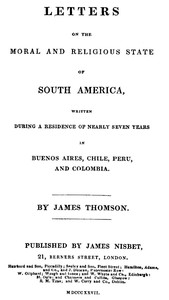
Letters on the Moral and Religious State of South America Written during a residence of nearly seven years in Buenos Aires, Chile, Peru and Colombia — Background and Themes
2
0
Project Gutenberg
2022
South America -- Description and travel; South America -- Social life and customs; Education -- South America; South America -- Religion
Readers of public-domain and historical texts
Project Gutenberg digital edition
en
Edition facts
Words: 79,357
Reading time: 346 min
Text sections: 10
Source:
Project Gutenberg record #67526
James Thomson's 1827 letters document his seven-year residence in South America, focusing on the distribution of Bibles and the establishment of Lancasterian schools. The work moves between Buenos Aires, Chile, Peru, and Colombia, with recurring attention to local responses to printed religious texts and the logistics of shipping and customs.
Editorial Edition Score
4.7/5
★★★★★
★★★★★
Calculated from edition completeness, EPUB availability, text structure and catalogue metadata. Not a user rating.
Edition quality
The letters in this volume were not written for publication. James Thomson, a Scottish educator and agent for the British and Foreign Bible Society, compiled them after his return to England in 1825, at the urging of friends. The result is a collection that preserves the immediacy of personal correspondence while offering a documentary record of religious and educational work in post-independence South America. Thomson’s preface acknowledges the letters’ abruptness and occasional indistinctness, since they were addressed to various recipients and are here arranged simply by date. The reader encounters a narrative shaped not by retrospective synthesis but by the unfolding of events as they were reported to distant correspondents.
A Structure Built from Extracts
Thomson warns that what follows are only extracts from longer letters. The published text therefore moves with a deliberate incompleteness: one letter breaks off, the next begins without transition. This fragmentary quality mirrors the uncertainty of communication across vast distances. In one passage, Thomson notes that a shipment of New Testaments sent to Truxillo could not be delivered due to the political situation there, and was instead carried to Guayaquil. The reader learns of this diversion only through a subsequent letter from a sea captain. The structure thus enacts the very difficulties of travel and correspondence that Thomson faced.
Recurring Images of Transit and Obstruction
Throughout the excerpts, physical movement is central: boxes of Testaments arrive by ship, are forwarded to inland cities, or remain on hand. Thomson writes of the Grecian bringing 2,500 Spanish New Testaments to Callao, and of two boxes from the Sesostris. Yet these shipments are frequently blocked—by port closures, by the impossibility of entering Truxillo, by the need to reroute cargo. The image of a box that cannot reach its intended destination recurs, as does the figure of the sea captain who becomes an impromptu distributor. Even the act of reading is portrayed as a kind of transit: the word of God moves through streets and into shops, carried by demand.
The Demand for Printed Texts
A striking pattern in the letters is the repeated description of local hunger for religious texts. In Guayaquil, shopkeepers and poor people read the Gospel in the streets; in Monte Cristi, old and young come after the captain requesting tracts. One tract was sent twenty leagues to a curate. The governor of Monte Cristi begged to keep a New Testament until the captain’s return. These anecdotes, reported secondhand, suggest a widespread desire for printed material that Thomson’s own letters cannot fully verify. The excerpts present this demand as both a cause for hope and a logistical challenge: Thomson must decide how to allocate limited supplies among competing regions.
Movement Between Scenes and Correspondents
The letters shift rapidly between locations and addressees. A single paragraph might move from Lima to Guatemala to Arequipa to Truxillo, then to Guayaquil and Monte Cristi. Thomson’s correspondents include individuals like Mr. Ronneberg and Captain Robson, but the reader is given little context for these figures. The effect is that of a network of contacts spread across the Pacific coast, each relaying news of distribution and local conditions. The letters do not linger in any one place; they accumulate details of shipments, customs duties, and school arrangements, building a mosaic of early republican South America through the lens of evangelical philanthropy.
Thomson’s letters resist easy summary. They are at once a travelogue, a missionary report, and a business correspondence. Readers should attend to the gaps between letters and the way information arrives piecemeal. The work rewards those who follow the movement of boxes and the names of ships, for it is in these concrete details that the texture of Thomson’s experience emerges.
Reader reflection
What did you think of this book?
Answer a few questions and save a private reflection on this device.
Your progress
0
/
10
2
Was reading this book enjoyable?
3
Is this a title you would suggest to others?
4
How much effort did this book require?
5
How understandable was the text?
6
How would you rate its originality?
7
Which part made the strongest impression?
8
Did you gain anything practical from the text?
9
What changed or sharpened your thinking?
10