1

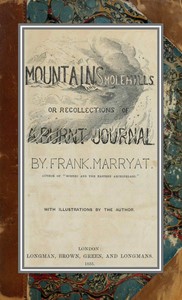
Mountains and molehills; or, Recollections of a burnt journal — Edition Insights
2
0
Project Gutenberg
2022
California -- Description and travel; California -- Gold discoveries; Law -- Political aspects -- California; Mines and mineral resources -- California; Ethnic groups -- California; Geology -- California; Marryat, Frank, 1826-1855
Readers of public-domain and historical texts
Project Gutenberg digital edition
en
Edition facts
Words: 103,197
Reading time: 449 min
Text sections: 14
Source:
Project Gutenberg record #69412
Frank Marryat's 1855 travel memoir recounts his three years in Gold Rush California with a wry, self-deprecating voice. Based on a burnt journal, the narrative blends sharp observations of mining life, frontier justice, and natural wonders, avoiding statistics in favor of vivid, often humorous anecdotes.
Frank Marryat opens his 1855 memoir by confessing that the pages are “the recollections of a ‘Journal burnt,’” an outline of what he saw and heard during three years in California. He warns that he may have “remembered too little,” yet prefers that to remembering too much, and promises a “rambling truthful story” over an elaborate one padded with fiction. This frank, almost offhand preface sets the tone for a narrative that moves at the pace of a campfire tale, shifting between precise description and dry humor. Marryat’s voice is that of a seasoned traveler—he had already published on Borneo—who treats his reader as a companion, not a pupil. He does not buttonhole; he invites you to close the book if it does not suit.
A Voice That Refuses to Buttonhole
Marryat’s narrative persona is established in the preface, where he declares, “I am no button-holder, and would rather, sir, that you would desert me at my second chapter, than that you should wade wearily through this volume.” This is not false modesty; it is a deliberate rhetorical stance. Throughout the excerpts, he maintains a conversational, self-deprecating tone, often undercutting his own authority. He admits to being “wanting in figures and statistics” and presents his work as a series of recollections rather than a systematic account. This voice allows him to shift between registers: a dry observation about Sacramento’s rats “coming out after dark in strong gangs, as if the town belonged to them” sits alongside a sober report on the Vigilance Committee’s summary executions. The reader is never allowed to forget that the author is selecting and shaping memory, not delivering a definitive record.
Pace and the Art of the Digression
The book’s pacing mirrors its origin in a burnt journal: it is episodic, with sudden leaps from the mundane to the dramatic. In one passage, Marryat describes the construction of a levee and the rats that plague Sacramento, then pivots to the Vigilance Committee’s rise. The rat anecdote—complete with a rat-catcher who fails to lure the rodents to a paddock—is told with comic timing, the punchline delivered by a single rat who “turned tail for the city.” Immediately afterward, the tone darkens as Marryat recounts how the committee “took upon themselves the dispensation of life and death.” These shifts are not jarring but deliberate, mimicking the way memory works: a vivid, trivial image can surface next to a grave one. Marryat controls tempo by lingering on a scene (the rat’s contemplative nose-scratch) before accelerating through a summary of executions.
Setting as Character: Rats, Hulks, and Racecourses
Marryat’s California is built from concrete, often odd details. Sacramento’s waterfront features “old dismantled hulks, now converted into floating houses,” from which rats “first landed that are now so distinguished … for their size and audacity.” The town of Brighton, when he visits, consists of little more than a racecourse and “one or two stables”; the rest of the town is not yet “developed.” These details do more than describe—they characterize the raw, provisional nature of Gold Rush settlements. The rats are a running joke, but they also signal the disorder that the Vigilance Committee tried to curb. Marryat’s eye for the incongruous (a racecourse in a barely existent town) and the grotesque (rats that “attack anything that may happen to have been left on the wharf”) gives his setting a lived-in, slightly surreal quality. He does not explain; he shows, and lets the reader infer the chaos beneath.
Marryat’s memoir rewards a reader who enjoys following a digressive, opinionated guide rather than a systematic historian. Pay attention to the asides: the rat-catcher’s failure, the half-built racecourse, the offhand mention of a friend’s quartz vein. These are not filler but the texture of a world where order is fragile and memory is selective. The book’s subtitle, Recollections of a Burnt Journal, is a promise that what survives is what struck the author most—and that is precisely what makes the account valuable.
Reader reflection
How will you remember this book?
Save your reaction, strongest insight, and memorable passage.
Your progress
0
/
10
2
Did this book hold your interest?
3
How likely are you to recommend this book?
4
How much effort did this book require?
5
What did you appreciate most?
6
How understandable was the text?
7
How strong was your personal connection to the text?
8
Was the book what you thought it would be?
9
What did this book teach you most?
10