1

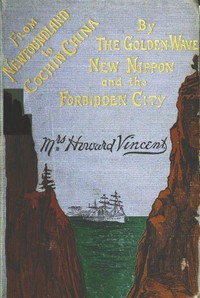
Newfoundland to Cochin China By the Golden Wave, New Nippon, and the Forbidden City — Background and Themes
19
8
Project Gutenberg
2016
Voyages and travels; Japan -- Description and travel; China -- Description and travel; Canada -- Description and travel
Readers of public-domain and historical texts
Project Gutenberg digital edition
en
Edition facts
Words: 104,466
Reading time: 455 min
Text sections: 13
Source:
Project Gutenberg record #51280
A late-Victorian travel narrative by Mrs. Howard Vincent, tracing a journey from Newfoundland to Cochin China via Canada, Japan, and China. The account blends personal observation with reports on British trade, offering vivid descriptions of landscapes, customs, and infrastructure, with a particular focus on the contrasts between Western and Eastern societies.
Editorial Edition Score
4.9/5
★★★★★
★★★★★
Calculated from edition completeness, EPUB availability, text structure and catalogue metadata. Not a user rating.
Edition quality
Mrs. Howard Vincent opens her account of a second circumnavigation with the sight of Newfoundland at dawn: 'a grey streak across the oval of the port.' The phrase sets the tone for a narrative that oscillates between precise visual detail and a sense of personal satisfaction at having left the sea behind. The book is structured as a series of geographical chapters—from 'Our Premier Colony' through the Canadian Rockies, Japan, China, and finally Cochin China—each blending travelogue with commentary on British trade and interests, contributed by Colonel Howard Vincent. The author's voice is that of an experienced traveler, addressing her child Vera in the dedication, and the text is punctuated by numerous illustrations that reinforce the documentary impulse.
The Peiho's Unpredictable Currents
The journey up the Peiho River to Peking becomes a sustained set piece in which the author tracks the river's 'aggravating' windings, noting that the actual distance covered after a series of bends equals 'about half a mile as the crow flies.' The narrative rhythm mirrors the boat's progress: a 'pleasant rush' with a favorable wind gives way to a calm requiring punting, then to a 'painful slow bit of tacking' when wind and stream are adverse. The crew's behavior—making fast to the bank if the wind is ahead—is recorded as a matter of practical observation. The author also notes the 'extraordinary phenomenon' of sails appearing to walk inland against the skyline, a visual trick produced by the river's meanders. This section exemplifies how the text uses the physical challenges of travel to structure its descriptive passages, turning a logistical annoyance into a source of narrative interest.
Graves, Coffins, and Chinese Customs
In a passage that moves from the specific to the general, the author describes the Chinese practice of placing coffins in open fields or along roads, noting a red-covered coffin 'standing like this, just outside a village.' She reports a superstition that burial within sight of water is lucky, explaining the rows of graves along riverbanks. The observation that 'the whole face of China is burrowed under by these graves' is attributed to an unnamed source, but the author adds her own detail: the unwieldy size of coffins, kept in houses for years, and the priority given by poor women to saving for grave-clothes. This section reveals a pattern in the text: the author moves from a striking visual detail to an explanation of underlying beliefs, often with a hint of bemusement at the contrast with Western practices. The tone is ethnographic but not judgmental, though the phrase 'objectionable custom' signals a clear cultural distance.
Mixed Teams and Ancient Ploughs
Along the Peiho, the author observes agricultural labor with an eye for incongruous combinations. Coolies in 'loose blue cotton garments' plough with 'ancient and rude ploughshares,' while the teams that pull them are 'delightfully mixed': an ox and horse, a donkey and mule, all pulling together. The carts resemble 'old Roman chariots,' and a favorite team is 'a bull with a tandem donkey.' The donkeys themselves are described with affection—'beautiful animals; small, but with sleek grey, brown and black coats, with the well-marked neck rings.' This attention to the material culture of transport and farming recurs throughout the book, linking the Canadian Rockies (where trains emerge from snow-sheds) to the Chinese countryside. The author's voice remains that of a curious outsider, noting details that a local might overlook, and her descriptions often carry a faint surprise at the efficiency of these improvised arrangements.
Readers approaching this work should attend to the interplay between the author's personal impressions and the statistical reports appended by Colonel Howard Vincent. The narrative is not a continuous story but a series of vignettes, each anchored in a specific location and often in a specific mode of transport—train, ship, or native boat. The illustrations, though not reproduced here, are clearly integral to the author's method of documentation. The book rewards those who read for concrete detail rather than plot, and who are interested in how a late-Victorian traveler negotiated the gap between expectation and experience.
Reader reflection
Before you leave, reflect on the book
Use these questions to collect your thoughts before moving on.
Your progress
0
/
10
2
How did the book work for you overall?
3
Is this a title you would suggest to others?
4
How easy was the book to follow?
5
How valuable was this book for your own interests?
6
Could you see yourself revisiting this book?
7
How understandable was the text?
8
Did you relate to its people, ideas, or situations?
9
What changed or sharpened your thinking?
10