1

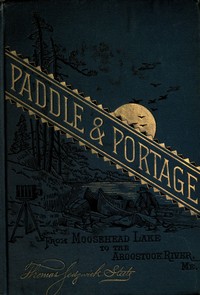
Paddle and portage, from Moosehead Lake to Aroostook River, Maine — Inside the Classic
18
13
Project Gutenberg
2024
Camping; Canoes and canoeing; Maine -- Description and travel; Piscataquis County (Me.) -- Description and travel; Aroostook County (Me.) -- Description and travel; Moosehead Lake (Me.); Aroostook River (Me. and N.B.)
Readers of public-domain and historical texts
Project Gutenberg digital edition
en
Edition facts
Words: 21,670
Reading time: 95 min
Text sections: 17
Source:
Project Gutenberg record #72708
Steele's 1882 account of a canoe trip from Moosehead Lake to the Aroostook River blends practical travelogue with local lore, including a long embedded story about a lost hunter named Johnny Way. The narrative shifts between first-person observation and transcribed dialect speech, revealing tensions between city and woods, planning and improvisation.
Editorial Edition Score
4.8/5
★★★★★
★★★★★
Calculated from edition completeness, EPUB availability, text structure and catalogue metadata. Not a user rating.
Edition quality
Steele opens his narrative not with a grand declaration but with a flimsy wharf and a complaint about railroad travel, immediately grounding the reader in the logistical realities of 1880s Maine. The book is structured as a chronological journey, but its texture comes from the interplay between Steele's own measured observations and the vernacular tales he collects along the way. The most striking of these is Hiram's story of Johnny Way, a city-bred youth whose solo trek through the snow becomes a cautionary tale about overconfidence in the woods. This embedded narrative occupies a substantial portion of the text, shifting the book from a straightforward travel account into something closer to a collection of regional folklore.
The City Man in the Woods
Throughout the excerpts, a recurring tension appears between the experienced woodsman and the novice from the city. Hiram's story of Johnny Way crystallizes this dynamic. Johnny is described as a “spruce lookin' chap” who had “heaps o' money” but was “raised in a hot-house.” His desire to prove himself leads him to ignore Hiram's advice and strike out alone, relying on a course marked in wet snow with a ramrod. The story is told entirely in dialect, with Hiram's voice carrying the weight of local knowledge: “I marked out his course in the wet snow. Says I, 'You see here, Johnny, that mark I jist made goes across Haymoak Lake to Stink Pond.'” The contrast between Johnny's eagerness and Hiram's growing unease—“I begun to feel terrible skittish about him”—creates a quiet suspense that the book does not resolve within the provided excerpts.
Dialect as a Narrative Device
Steele does not simply report events; he hands the narration over to a local guide for an extended stretch. Hiram's speech is rendered in a thick dialect that marks him as an insider: “'twas 'long about the Autumn of 1870,” “enj'yed the fust winter so rattlin' well,” “a mighty unsartin kind of bizness.” This choice gives the book a layered quality—Steele's own polished prose frames a raw, oral tale. The dialect is not merely decorative; it carries specific information about place and character. Hiram's use of terms like “spotted line” and “all hunk” grounds the story in a particular lexicon of the Maine woods. The effect is to make the reader feel like an eavesdropper on a campfire conversation, with all the digressions and repetitions that entails.
The Unreliable Map
The book's title promises a route from Moosehead Lake to the Aroostook River, but the excerpts reveal a journey that is as much about getting lost as following a course. The map mentioned in the front matter—20 × 30 inches of the canoe courses of Northern Maine—is noted as missing from the source copies, a lacuna that mirrors the uncertainty within the text. Hiram's instructions to Johnny are precise yet fragile: a line scratched in snow, a log camp on Little Leadbetter Pond. The landscape itself resists easy navigation, with lakes named Stink Pond and Haymoak Lake, and carries that test both men and horses. Steele's own party faces “rough water” and “cold and ice,” while the pack-horse league suggests a comically overburdened approach to portage. The book, then, is not a simple itinerary but a record of the gap between intention and experience.
Readers should pay attention to the shifts in narrative voice, particularly the long embedded story that interrupts the travelogue. The book rewards those who read slowly, noting the specific place names and the way Steele lets his guide's dialect carry the emotional weight of the journey. The missing map is not a flaw but a fitting absence—this is a book about navigating without one.
Reader reflection
What did you think of this book?
Answer a few questions and save a private reflection on this device.
Your progress
0
/
10
2
Was reading this book enjoyable?
3
How likely are you to recommend this book?
4
How much effort did this book require?
5
How clear did the writing feel?
6
Did the book give you something worth debating?
7
Did the book meet your expectations?
8
Did the book offer a fresh perspective?
9
Which lesson or insight stayed with you?
10