1

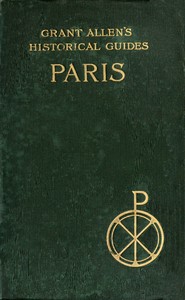
Paris Grant Allen's Historical Guides — Inside the Classic
17
8
Project Gutenberg
2015
Paris (France) -- Description and travel; Paris (France) -- Guidebooks
Readers of public-domain and historical texts
Project Gutenberg digital edition
en
Edition facts
Words: 94,478
Reading time: 411 min
Text sections: 11
Source:
Project Gutenberg record #49907
Grant Allen's 1897 guide to Paris focuses on historical and artistic context rather than practical travel details. The author guides readers through the Louvre's Italian primitives, tracing stylistic shifts in Madonna paintings by Cimabue, Botticelli, and others, with precise observations on iconography and technique.
Editorial Edition Score
4.8/5
★★★★★
★★★★★
Calculated from edition completeness, EPUB availability, text structure and catalogue metadata. Not a user rating.
Edition quality
Grant Allen's Paris (1897) is not a conventional guidebook. In his introduction, Allen explicitly distinguishes his project from Baedeker, Joanne, or Murray: he aims to supply 'historical and antiquarian information' that helps a tourist 'understand, and therefore to enjoy, the architecture, sculpture, painting, and minor arts.' The book assumes a reader who already has a practical guide for hotels and cab fares, and instead offers a cultural framework built from thirty-five years of travel and research.
The excerpts reveal a work intensely focused on visual analysis, particularly of Italian Renaissance painting in the Louvre. Allen walks the reader through galleries, pointing out specific works by number, comparing types of Madonnas, and noting shifts in style—from the 'almond-eyed' early Sienese to the 'bland and round-faced Umbrian type' and the 'mystical and somewhat languid' Botticelli. His method is cumulative: each painting is a data point in an argument about artistic development.
A Guide for the Cultured Traveller
Allen's preface makes clear his intended audience: 'especially Americans' who come to Europe with 'an honest and reverent desire to learn.' He does not provide lists of monuments or practical tips; instead, he offers a structured inquiry into why a city grew where it did, how it gained importance, and what arts it fostered. The book's plan is methodical: first the site's geography, then its historical growth, then its artistic achievements. This approach treats the city as a living text to be interpreted, not merely visited.
The excerpts show Allen in the Louvre, guiding the reader through the Salle des Primitifs with a connoisseur's eye. He compares a Cimabue to a Giottesque work, notes the 'characteristic softness' of Sienese Madonnas, and identifies saints by their attributes—'St. Peter (keys), St. Paul (sword), St. John Baptist (camel-hair).' His voice is that of a patient lecturer, assuming the reader stands before the paintings.
Reading the Madonna: Iconography and Style
Allen's analysis of Madonna paintings in the Louvre is remarkably detailed. He groups works by school—Sienese, Umbrian, Florentine—and traces evolving conventions. For instance, he notes that in earlier works the Child is draped, but in Gentile da Fabriano and Perugino 'the growing love for the nude begins to exhibit itself.' He also comments on haloes, angel groupings, and the introduction of donor figures.
He points out specific paintings by their Louvre numbers (e.g., 1620, 1666, 1295) and describes their features: the 'early almond-eyed type' of a Sienese Madonna, the 'rounded face' of Filippo Lippi's model Lucrezia Buti, the 'Medici children' features in Botticelli's angels. Allen treats each work as evidence of a painter's 'artistic personality' and of broader stylistic shifts. His method is comparative: he asks the reader to 'compare them again from our present standpoint' after each new observation.
The Louvre as a Classroom for Art History
The excerpts show Allen using the Louvre's collection as a teaching tool. He does not simply list masterpieces; he constructs a narrative of artistic development. For example, he moves from a 'simple Enthroned Madonna of the School of Giotto' (1315) to a work by Neri di Bicci, a 'belated follower of Giottesque models,' then to Filippo Lippi's introduction of a new facial type. Each step illustrates a change in technique or sensibility.
Allen's language is precise and observational. He notes that in Perugino's later work (1565), the Baptist and St. Catherine are 'thrown into the background behind the Madonna,' showing a compositional advance. He also remarks on the 'rapid advance in the treatment of accessories' in Filippo Lippi's angels. The guide assumes the reader can follow these visual cues, and it provides the vocabulary to articulate them.
Allen's Distinctive Voice and Method
Allen's prose is direct and didactic, but not dry. He uses phrases like 'observe that,' 'compare with this,' and 'note the complete transformation' to create a sense of active looking. His observations are grounded in specific details: the 'two tiny votaries' in one Madonna, the 'choir of angels, both surrounding and beneath the throne' in another. He also connects paintings to historical figures—Pandolfo Malatesta, Lucrezia Buti—grounding art in biography.
The guide's structure is cumulative: each new painting builds on previous observations. Allen expects the reader to remember earlier points and apply them. His method is not to provide exhaustive descriptions but to train the eye. The excerpts suggest a book that is as much about how to see as about what to see.
Allen's Paris rewards a reader willing to engage actively with its detailed analyses. The guide is best used in front of the works it describes, with the Louvre's room numbers and painting labels at hand. Its value lies not in comprehensive coverage but in the sharpness of its observations and the coherence of its historical narrative. For those interested in the development of Italian painting, it offers a focused, opinionated tour that still feels fresh.
Reader reflection
Before you leave, reflect on the book
Use these questions to collect your thoughts before moving on.
Your progress
0
/
10
2
Did this book hold your interest?
3
Would you recommend this book to another reader?
4
Did the language feel accessible?
5
Would this book work well in a reading group?
6
How distinctive were its ideas or approach?
7
What was the strongest part of the book?
8
How understandable was the text?
9
What is the main idea you are taking away?
10