1

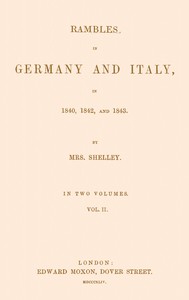
Rambles in Germany and Italy in 1840, 1842, and 1843, vol. 2 of 2 — Edition Insights
27
16
Project Gutenberg
2024
Italy -- Description and travel; Germany -- Description and travel; Authors, English -- 19th century -- Biography; British -- Europe -- History -- 19th century; Shelley, Mary Wollstonecraft, 1797-1851 -- Travel -- Italy; Shelley, Mary Wollstonecraft, 1797-1851 -- Travel -- Germany
Readers of public-domain and historical texts
Project Gutenberg digital edition
en
Edition facts
Words: 69,032
Reading time: 301 min
Text sections: 10
Source:
Project Gutenberg record #74301
Mary Shelley's second travel volume shifts from German landscapes to Italian cities, blending sharp art criticism, political analysis of the Carbonari, and personal reflections on architecture and painting, with a notable change in pace from brisk Alpine travelogue to sustained cultural commentary.
Editorial Edition Score
4.8/5
★★★★★
★★★★★
Calculated from edition completeness, EPUB availability, text structure and catalogue metadata. Not a user rating.
Edition quality
Mary Shelley opens this second volume with a departure from the brisk travelogue of the first: Prague is introduced through 'strange and wild legends' and the city's Sclavonian heritage, immediately establishing a tone of historical reflection. The narrative voice here is more deliberate, pausing to describe the Laurenzi Berg and the Hradschin before moving southward. As the journey progresses into Italy, the pace shifts markedly. In Florence, Shelley lingers over paintings and architecture, offering detailed comparisons between Gothic and Italian styles—'Gothic architecture resembles the overarching branches'—and delivering pointed critiques of artistic degeneracy. This volume is as much a cultural essay as a travel record.
From Alpine Passes to Venetian Canals
The first letters of Part III cover a rapid descent from Prague through Mülchen, Budweis, Linz, and the Tyrol, with Shelley noting village fêtes and the Pass Strub. The prose moves quickly, matching the pace of travel. But upon reaching Verona and Venice, the rhythm slows. In Letter VI, she describes the journey to Venice and the Leone Bianco with a traveler's eye for detail, yet the narrative soon settles into longer, more analytical passages. The change is palpable: the hurried impressions of German towns give way to sustained observations of Venetian palaces, gondolieri, and the Basilica of St. Mark. Shelley's voice becomes more authoritative, especially in her critique of Venetian society and the 'titles of the nobility.'
Art Criticism and the Florentine Gaze
In Florence, Shelley's writing adopts the tone of an art connoisseur. She examines Cosimo Rosselli, Ghirlandajo, and Beato Fra Angelico with a critical eye, lamenting the 'degeneracy' of later schools. Her description of a portrait of Dante is particularly vivid: 'His lip is proud—for proud, every contemporary asserts that he was.' She contrasts the 'solemn tranquillity' of Gothic architecture with the 'bare' interiors of Italian churches, arguing that Italian architects 'seem not to have known well what to do with the vast space.' This section is dense with aesthetic judgment, revealing Shelley's strong opinions on the infancy and decline of art. The pace here is unhurried, allowing for careful analysis of frescoes and sculpture.
Political Undercurrents in Tuscany
Letter XIV, 'The Carbonari,' marks a sharp turn from art to politics. Shelley discusses the 'spirit in Italy tending towards improvement' and contrasts Tuscany's relative contentment under Leopold I with the 'undisguised hatred' in Lombardy and the 'intolerable' misrule of the Papal States. She argues that the French occupation, while destructive of nationality, had a 'certain good effect' by exposing the curse of Italy's divisions. The prose becomes more argumentative and less descriptive, with a slower, more deliberate pace suited to political analysis. Shelley's voice here is that of a commentator on contemporary affairs, grounding her travel observations in a broader historical context.
Readers attentive to shifts in narrative tempo will find this volume rewarding: the early, rapid-fire letters give way to extended meditations on art and politics. Shelley's voice evolves from that of a curious traveler to a confident critic and political observer. Pay particular attention to how she uses architectural and artistic comparisons to frame her judgments, and note the way her prose slows when she encounters subjects that stir her strongest opinions—whether a fading fresco or the state of Italian governance.
Reader reflection
How did this book work for you?
Your answers remain private and are stored only in this browser.
Your progress
0
/
10
2
Did this book hold your interest?
3
Would you pass this book on to a friend?
4
What was the reading difficulty like?
5
How strongly did the book affect you emotionally?
6
Would this book work well in a reading group?
7
Which element worked best for you?
8
Would you read this book again?
9
What is the main idea you are taking away?
10