1

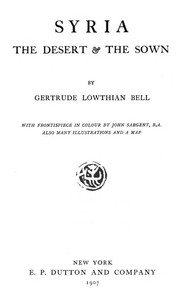
Syria, the Desert & the Sown — Inside the Classic
2
0
Project Gutenberg
2020
Palestine -- Description and travel; Syria -- Description and travel; Syria -- Social life and customs; Palestine -- Social life and customs; Lebanon -- Description and travel; Lebanon -- Social life and customs; Bell, Gertrude Lowthian, 1868-1926 -- Travel -- Middle East
Readers of public-domain and historical texts
Project Gutenberg digital edition
en
Edition facts
Words: 98,258
Reading time: 428 min
Text sections: 15
Source:
Project Gutenberg record #63731
Gertrude Bell's 1907 travel narrative weaves together archaeological observation, ethnographic detail, and personal anecdote as she journeys through Syria, Lebanon, and Palestine, moving between desert encampments and settled villages.
Editorial Edition Score
4.9/5
★★★★★
★★★★★
Calculated from edition completeness, EPUB availability, text structure and catalogue metadata. Not a user rating.
Edition quality
Bell structures her account as a journey threaded with the words of those she meets, from shepherds to Turkish officials. The preface declares her intent to let her companions 'tell their own tale' by stringing their stories 'upon the thread of the road.' This method produces a narrative that shifts between archaeological description, such as the Hittite mound of Kadesh with its 'grassy swards' and turning mill wheel, and the immediate social encounters of the march. The movement between desert and sown—the Bedouin camp and the Druze guest-chamber—gives the book its title and its rhythm.
Thread of the Road
The book's structure is explicitly governed by the path of travel. Bell describes her method as 'stringing' the words of her informants 'upon the thread of the road.' This is not a metaphor: the narrative follows her itinerary from Damascus to Palmyra, through the Orontes valley, and into the mountains of the Noṣairiyyeh. Each stage introduces new interlocutors—shepherds, soldiers, sect members—whose speech is recorded as part of the day's progress. The road itself becomes a unifying device, linking disparate scenes without forcing them into a single argument. Bell's attention to the physical details of movement—the barking of her dog Kurt at night, the weather that 'was gloriously fine' for a circuit to Tell Nebi Mendu—anchors the reader in the sensory experience of travel.
Recurring Images: The Mound and the Mill
Certain images recur with the insistence of a leitmotif. The tell, or artificial mound built by successive generations, appears repeatedly as a figure for historical accumulation. At Kadesh, Bell notes that 'each succeeding generation has built upon the dust of those that went before,' making the mound 'higher and higher, and doubtless richer and richer in the traces of them that lived on it.' Yet the same mound is also a present obstacle: it 'cannot be excavated thoroughly' because of the 'miserable mud hovels' that now occupy it. The mill wheel turning 'merrily in the rushing stream' at the foot of the tell offers a contrasting image of continuous, unreflective life. These paired images—the layered past and the active present—recur throughout the text, often in close juxtaposition.
Movement Between Desert and Sown
The book's title announces its central geographical opposition, but Bell's treatment of the desert-sown boundary is more fluid than binary. The valley of the Orontes, she observes, 'was formerly an Arab camping ground and is still frequented in dry seasons by a few sheikhs,' but 'the bulk of the Bedouin have been driven out by cultivation.' The line between nomadic and settled life is not fixed; it shifts with seasons, politics, and the encroachment of agriculture. Bell's own movement mirrors this fluidity: she stays in black tents and in guest-chambers, among Bedouin and among Druze. Her narrative voice adjusts to each setting, recording the 'talk that passed from lip to lip round the camp fire' with the same care she gives to the 'more cautious utterances of Turkish and Syrian officials.'
The Observer's Position
Bell is explicit about her role as a foreign observer, yet she resists the posture of the omniscient expert. Of the Noṣairiyyeh sect, she writes that she adopts 'an attitude of benevolent neutrality,' having spent five days in their mountains and 'had no reason to raise a complaint.' This qualified judgment is typical: Bell offers observations but hedges them with the limits of her experience. She notes that native report 'speaks ill' of the Noṣairiyyeh, 'following the invariable custom by which people whisper scandal of what they are not allowed to understand.' The sentence acknowledges both the unreliability of hearsay and the difficulty of penetrating a closed society. Bell's own position remains that of a traveler who records what she sees and hears, without claiming to have uncovered the truth beneath.
Readers will find that Bell's narrative rewards attention to its layered structure: the thread of the road, the recurring images of mound and mill, the shifting boundary between desert and sown. The book is best approached not as a systematic survey but as a series of encounters, each framed by the circumstances of travel. Bell's voice—curious, precise, and self-aware—holds these fragments together, offering a portrait of a region in transition at the turn of the twentieth century.
Reader reflection
How will you remember this book?
Save your reaction, strongest insight, and memorable passage.
Your progress
0
/
10
2
How did the book work for you overall?
3
Would you pass this book on to a friend?
4
How easy was the book to follow?
5
Did this book create an emotional response?
6
Would you start a conversation about this book?
7
What was the strongest part of the book?
8
How original did the book feel?
9
What changed or sharpened your thinking?
10