1

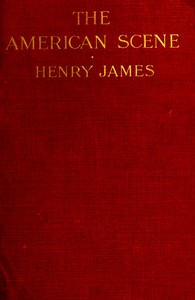
The American scene — Key Ideas to Explore
2
0
Project Gutenberg
2022
United States -- Description and travel; United States -- Social life and customs -- 1865-1918; Atlantic States -- Description and travel; James, Henry, 1843-1916 -- Travel -- Atlantic States; Travelers' writings, American
Readers of public-domain and historical texts
Project Gutenberg digital edition
en
Edition facts
Words: 161,861
Reading time: 704 min
Text sections: 23
Source:
Project Gutenberg record #68717
Henry James's 1907 travelogue records his return to America after a 25-year absence, blending sharp observation of landscapes and social change with a deeply personal, often ambivalent, meditation on national identity and the erosion of the old New England spirit.
Editorial Edition Score
4.9/5
★★★★★
★★★★★
Calculated from edition completeness, EPUB availability, text structure and catalogue metadata. Not a user rating.
Edition quality
Henry James’s preface to The American Scene establishes a distinctive double perspective: he returns to the United States after nearly a quarter-century abroad, claiming both the freshness of a stranger and the acuity of an initiated native. This paradoxical stance—eager to gather impressions yet prepared to remain “imperturbably inert” before matters he cannot absorb—shapes every subsequent page. The book does not aim to inform or report; it transcribes a cultivated sense of aspects and prospects, a personal record of what the American scene yielded to a patient, discriminating eye.
Readers should expect a work of impressionistic travel writing, not a systematic survey. James lingers over buildings, social habits, and the tone of places, often finding in a single church or street corner the emblem of a larger cultural condition. His prose is intricate, his judgments oblique, and his attention to language itself a central subject.
The Observer’s Vantage
The preface lays out James’s method with unusual candor. He will “go to the stake” for his gathered impressions, yet he acknowledges that many matters—those already treated in “prodigious reports and statistics”—will find him incapable of information. This is not a confession of failure but a declaration of intent: the book will record only what his sensibility registers. The reader is thus invited to attend not to facts but to the quality of attention itself. James’s language of “vibration” and “curiosity” suggests a nearly physical receptivity, a tuning of the mind to the atmosphere of places. When he later describes Park Street Church as “the most interesting mass of brick and mortar” in Boston, it is because the building has become, for him, a vessel of meaning—its threatened demolition a test of civic virtue. The preface warns us that such moments of symbolic intensity are what the book seeks, and that we must read with an ear for implication rather than assertion.
Boston and the Puritan Formula
In the excerpt concerning Boston, James focuses on Park Street Church as a “cynosure” menaced by a proposed business block. The episode crystallizes a recurring concern: the pressure of commercial greed on older forms of communal life. James wonders aloud whether the “old New England spirit” still has anything to give—whether the formula of “Puritanism educated” retains any intellectual or aesthetic vitality. He invokes the “literary constellation” of Emerson’s age, asking if the cornucopia is empty. The passage is notable for its indirectness; James does not answer his own questions. Instead, he lets the scene—the church, the July air, the friend’s words—generate a mood of elegiac uncertainty. The reader is left to weigh the evidence of decay against the possibility of renewal. James’s prose here is at its most sinuous, moving from the specific threat to the church to a broader meditation on charm, money, and impatience. The moral he draws—that charm “mocks our money and our impatience”—is typical of his method: a local observation expands into a general principle, but always tethered to the concrete.
The Texture of Place
Throughout the excerpts, James’s attention to physical detail is precise and evocative. He notes the “bright July air,” the “freshly-perceived value” of the church’s position, the “huge square of innumerable tiers and floors” that threatens it. These details are never merely decorative; they carry argument. The church’s value is not inherent but relational—it depends on its setting, its civil function, its place in the town’s visual and moral economy. James’s language of “the eye of financial envy” personifies greed as a force with a “fat shoulder” that pushes. This anthropomorphism is characteristic: he treats cities as living organisms, buildings as actors, and social forces as palpable presences. The reader should watch for such moments where the inanimate becomes animate, for they mark the points where James’s impressionism becomes most intense. His descriptions of Boston’s “ambient air” and the “symptoms” of intellectual promise treat the city as a body to be diagnosed, its health measured by the quality of its public life.
Reading the Unfinished Record
The excerpts provided are fragmentary, drawn from the preface and an early chapter on Boston. They do not reveal the full arc of James’s journey—which included stops in New York, Philadelphia, Richmond, and the South—nor his later reflections on race, immigration, and the American woman. What they do offer is a clear sense of his method and preoccupations. The reader should approach the complete text as a series of discrete impressions, each anchored in a specific encounter. James’s sentences are long and parenthetical, his meaning often deferred. It helps to read aloud, attending to rhythm and emphasis. The book rewards patience: a single paragraph may contain a dozen observations, each qualifying the last. Above all, remember that James is not describing America as it was, but as it appeared to a particular consciousness at a particular moment. The value of the book lies not in its accuracy but in the depth and honesty of its seeing.
James’s The American Scene is best read as a companion to his novels—a nonfictional counterpart to his fictional explorations of transatlantic encounter. The same themes of innocence and experience, tradition and change, surface here in direct observation. Let the book’s digressions and hesitations guide you; they are not flaws but features of a mind working at full stretch. What emerges is less a portrait of a country than a portrait of a sensibility confronting its own past.
Reader reflection
How will you remember this book?
Save your reaction, strongest insight, and memorable passage.
Your progress
0
/
10
2
What was your overall reaction to the book?
3
How likely are you to recommend this book?
4
How much effort did this book require?
5
Did anything about the book feel genuinely new?
6
Was the book easy to understand?
7
How would you describe its reading pace?
8
What did you appreciate most?
9
What is the main idea you are taking away?
10