1

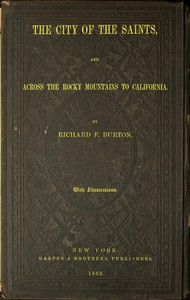
The City of the Saints, and Across the Rocky Mountains to California — Reading Notes
2
0
Project Gutenberg
2021
Overland journeys to the Pacific; Utah -- Description and travel; Burton, Richard Francis, Sir, 1821-1890 -- Travel -- Utah; Latter Day Saints -- Utah -- History -- 19th century; Salt Lake City (Utah) -- History
Readers of public-domain and historical texts
Project Gutenberg digital edition
en
Edition facts
Words: 309,933
Reading time: 1348 min
Text sections: 51
Source:
Project Gutenberg record #66791
Burton's 1860 journey to Salt Lake City blends travel diary, ethnographic observation, and critical commentary on Mormon society, structured by movement across landscapes and into institutional spaces like the Tabernacle.
Editorial Edition Score
4.9/5
★★★★★
★★★★★
Calculated from edition completeness, EPUB availability, text structure and catalogue metadata. Not a user rating.
Edition quality
Richard F. Burton’s account of his 1860 overland journey to Salt Lake City is structured as a movement through physical and social landscapes, from the Rocky Mountain crossing to the heart of Mormon institutional life. The narrative shifts between descriptive travelogue and ethnographic reportage, with Burton often pausing to document the organization of religious conferences, the layout of settlements, and the demeanor of leaders like Brigham Young. His prose carries a detached, analytical tone, punctuated by dry wit and a preference for concrete detail over romanticized scenery.
Movement Across Terrain
Burton’s journey is marked by careful attention to the physical challenges of the trail—muddy roads, scarce water, and the slow progress of wagons. He notes how the landscape itself dictates the pace and mood of travel, with the Rocky Mountains serving as a formidable threshold. The narrative often pauses to describe the condition of roads, the state of rivers, and the quality of campsites, grounding the reader in the material realities of nineteenth-century overland travel. These details are not mere decoration; they shape the rhythm of the account and underscore the isolation of Mormon settlements.
The Conference as Spectacle
Burton devotes considerable space to the Mormon General Conference, describing the assembly of faithful from across the territory. He lists the hierarchy of church leaders with precision, noting their titles and seating arrangements. The singing of hymns and the order of prayers are recorded with an ethnographer’s eye. Burton observes the crowd’s eagerness for admission and the logistical challenges of accommodating thousands, framing the event as both a religious gathering and a social fair. His account captures the tension between the sacred and the mundane, as the faithful travel in droves despite impassable roads.
Recurring Images of Water and Irrigation
Throughout the excerpts, water appears as a recurring motif—melting snows, rare rain showers, and irrigation channels. Burton notes that the region had historically been dry, with farmers depending on mountain snowmelt. He records the recent abundance of rain and snow, which turned roads to mud but also signaled agricultural hope. This attention to water reflects both the practical concerns of settlement and the symbolic importance of controlling a scarce resource. The image of muddy roads and crowded streets during Conference ties the physical environment to the social calendar.
Burton’s Editorial Voice
Burton frequently interjects with editorial asides, such as his remark that a newspaper article was “probably written by a Mormon elder” or his observation that it was “the fashion” to assume a Gentile persona. These comments reveal his skepticism and his awareness of the constructed nature of public narratives. He also includes a lengthy epigraph from Robert Southey, warning of religious fanaticism in America, which frames his own investigation as part of a broader discourse. Burton’s voice is that of a critical observer, never fully immersed but always attentive to the gap between appearance and reality.
Burton’s narrative rewards readers who attend to the interplay between movement and stasis—the journey across the plains versus the fixed rituals of the Tabernacle. His eye for detail and his willingness to let scenes unfold without premature judgment make this a valuable document of mid-century Mormon society. Readers should approach the text as a layered travelogue, where the physical landscape and the social landscape are never entirely separate.
Reader reflection
Your personal reading reflection
Build a private reading journal entry for this title.
Your progress
0
/
10
2
How much did you enjoy the reading experience?
3
Would you pass this book on to a friend?
4
What was the reading difficulty like?
5
How strong was your personal connection to the text?
6
Was the book what you thought it would be?
7
How useful did the reading feel?
8
Did the story or argument move comfortably?
9
What changed or sharpened your thinking?
10