1

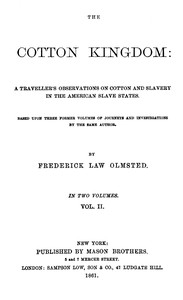
The Cotton Kingdom, volume 2 (of 2) — Reading Notes
20
14
Project Gutenberg
2024
Southern States -- Description and travel; Southern States -- Economic conditions; Cotton growing -- Southern States -- History -- 19th century; Slavery -- Southern States
Readers of public-domain and historical texts
Project Gutenberg digital edition
en
Edition facts
Words: 146,432
Reading time: 637 min
Text sections: 25
Source:
Project Gutenberg record #72677
Olmsted's second volume shifts from travelogue to economic analysis, examining absentee ownership, the overseer system, and the consolidation of slave labor on large plantations in Louisiana and Mississippi.
Editorial Edition Score
4.9/5
★★★★★
★★★★★
Calculated from edition completeness, EPUB availability, text structure and catalogue metadata. Not a user rating.
Edition quality
In this second volume, Olmsted moves beyond the road narrative of his earlier travels to focus on the structural mechanics of the cotton plantation system. He devotes sustained attention to the absentee planter class, arguing that many large estates are run by hired overseers while owners reside elsewhere—often in the North or Europe. The tone becomes more analytical, with passages that read like economic reports rather than travel sketches. Olmsted draws on census data to estimate that half of Louisiana's slaves belong to estates of fifty or more, and that nine-tenths of those slaves live on plantations where the owner is only transiently present. This shift in voice—from observer to statistician—marks a deliberate change in pace and purpose.
Absentee Ownership and the Overseer's Domain
Olmsted repeatedly returns to the figure of the absent owner. He describes plantations as “retreats from general society,” used in winter like Berkshire villas by wealthy Northerners. The consequence, he argues, is that slaves are left “to the nearly unlimited government of hireling overseers.” This observation is not anecdotal; he attempts to quantify it. Using the 1850 census, he calculates that about half of Louisiana’s slaves and one-third of Mississippi’s belong to estates of fifty or more slaves, and that nine-tenths of those slaves live on plantations where owners reside only transiently. The language is precise, almost clinical, but the implication is clear: the system concentrates power in the hands of men who have no long-term stake in the land or its people.
Economic Consolidation and the Disappearance of Small Planters
Olmsted traces a feedback loop: high cotton prices raise the price of slaves, which in turn makes it harder for small capitalists to enter the market. Large plantations, he notes, “pay a much larger per centage on the capital invested in them than smaller ones.” He acknowledges that the only plausible economic defense of slavery is the advantage of associated labor—an advantage he points out is equally available to large free-labor factories. The argument is careful, almost concessive, but it undercuts the moral claims of slavery advocates. He observes that the number of large plantations is “rapidly increasing,” and that owners can use credit from slave dealers to acquire additional estates. The pace of the prose here is deliberate, building a case through accumulation of detail rather than rhetorical flourish.
The Migratory Planter and the Social Vacuum
Olmsted draws a portrait of the wealthy planter as a seasonal visitor. He notes that it is “rare that a plantation of this class can have a dozen intelligent families residing within a day’s ride of it.” The social isolation is a direct result of the plantation scale. He speculates that the summer visitors to Northern resorts and European tourists from the South are “chiefly of the migratory, wealthy class,” and that such persons are “much less influenced in their character and habits by association with slaves.” The observation is understated but pointed: the men who own the most slaves have the least direct contact with them. The voice here is that of a traveler who has seen the reality behind the reputation for Southern hospitality—a hospitality that, Olmsted implies, is a necessary compensation for the loneliness of the large estate.
Readers should note that Olmsted’s method in this volume is cumulative rather than dramatic. He builds his argument through repeated examples and statistical inference, not through scenes of confrontation or moral outrage. The pace is steady, even patient, and the voice is that of a man who expects his evidence to speak for itself. Pay attention to the moments when he shifts from description to calculation—those transitions mark the core of his analytical project.
Reader reflection
How will you remember this book?
Save your reaction, strongest insight, and memorable passage.
Your progress
0
/
10
2
What was your overall reaction to the book?
3
Would you encourage someone else to read it?
4
What was the reading difficulty like?
5
How did the pace of the book feel?
6
How personally connected did you feel to the book?
7
How distinctive were its ideas or approach?
8
Is this a title worth rereading?
9
What is the main idea you are taking away?
10