1

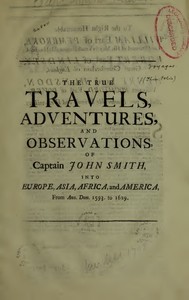
The True Travels, Adventures, and Observations of Captain John Smith into Europe, Asia, Africa, and America From Ann. Dom. 1593 to 1629 — Text and Context
2
0
Project Gutenberg
2017
Voyages and travels; Smith, John, 1580-1631
Readers of public-domain and historical texts
Project Gutenberg digital edition
en
Edition facts
Words: 35,064
Reading time: 153 min
Text sections: 5
Source:
Project Gutenberg record #55199
John Smith's 1630 travel narrative blends firsthand adventure with antiquarian curiosity, cataloging cities, ruins, and customs across Europe, Asia, Africa, and America, while defending his reputation against stage distortions.
Editorial Edition Score
4.7/5
★★★★★
★★★★★
Calculated from edition completeness, EPUB availability, text structure and catalogue metadata. Not a user rating.
Edition quality
John Smith opens his True Travels with a defensive preface: he has been “taxed to have writ too much, and done too little,” and his exploits have been “acted … upon the Stage, and racked … at their Pleasure.” To correct misrepresentations, he offers this “true Discourse,” compiled at the urging of antiquary Sir Robert Cotton. The work is not a continuous memoir but a series of geographical and observational chapters, mixing personal narrative with descriptions of cities, monuments, and political histories. Smith’s voice is that of a soldier-scholar, keen to record both his own hazards and the “Co-Partners” who shared them.
A Traveler’s Catalog of Ruins and Relics
In the excerpt describing Morocco, Smith shifts from personal itinerary to antiquarian inventory. He notes the three Golden Balls of Africa atop a Christian church steeple, “hollow within,” weighing “700 weight of pure Gold,” and recounts a legend: a betrothed princess set them up as a monument after her prince’s death, then “vowed Virginity all her Life.” The passage then catalogs the Alfantica (a guarded merchant warehouse), the Inderea (a Jewish quarter), and the ruined universities “now but Stables for Fowls and Beasts.” Smith’s eye for decay is precise: “Walls of Earth are with the great fresh Floods washed to the ground,” and a once-fabled garden is “nothing but Dung-hills, Pigeon-Houses, Shrubs and Bushes.” This blend of measurement, legend, and lament typifies his observational method throughout the book.
The Politics of Patronage and Self-Justification
The dedication to William Earl of Pembroke, Robert Earl of Lindsey, and Henry Lord Hunsdon reveals Smith’s reliance on noble patronage. He presents his work as a response to Sir Robert Cotton’s request to “fix the whole Course of my Passages in a Book by it self.” Smith also references his earlier Sea Grammar, printed by his friend Sir Samuel Saltenstall, which “hath found such good Entertainment abroad.” The preface is a bid for shelter “against all Storms that dare threaten,” framing the True Travels as both a monument to his companions and a defense of his own reputation. The catalog subject “Voyages and travels” thus understates the work’s rhetorical purpose: it is as much a legal brief for Smith’s honor as a geographical record.
Geographic Scope Versus Narrative Coherence
Smith’s itinerary in the excerpt from Chapter XVIII is a breathless list: “Dresden in Saxony, Magdeburgh and Brunswick; Cassel in Hessen; Wittenberg, Vilum, and Minekin in Bavaria; Augsburg, and her Universities; Hama, Frankford, Mentz, the Palatinate; Worms, Spires, and Straburg.” This catalog style, typical of early modern travel writing, prioritizes coverage over narrative. The book’s title promises travels into Europe, Asia, Africa, and America, but the excerpts show Smith moving rapidly from city to city, often without connective storytelling. The catalog subject “Smith, John, 1580-1631” might imply a biography, yet the text is less a personal story than a geographical survey punctuated by anecdotes. Readers expecting a continuous adventure will find instead a series of discrete observations, each anchored to a place rather than a plot.
Smith’s True Travels rewards readers who approach it as a period artifact of travel writing, where measurement, legend, and self-defense coexist. The excerpts show a narrator more concerned with accurate description than with dramatic arc, and the book’s structure—dedication, geographical chapters, marginal notes—reflects its dual role as personal vindication and learned compendium. For those interested in early modern perceptions of the world, Smith’s voice offers a direct, if sometimes defensive, window into how one soldier-scholar cataloged the known globe.
Reader reflection
What was your reading experience?
Capture what you thought, learned, and would like to remember.
Your progress
0
/
10
2
What was your overall reaction to the book?
3
Would you recommend this book to another reader?
4
How easy was the book to follow?
5
How clear did the writing feel?
6
Could you see yourself revisiting this book?
7
Did the story or argument move comfortably?
8
How useful did the reading feel?
9
What did this book teach you most?
10