1

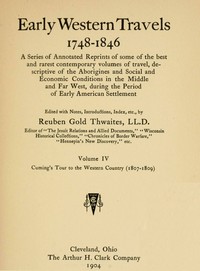
Cuming's tour to the western country (1807-1809) — A Reader’s Guide
27
16
Project Gutenberg
2024
Pennsylvania -- Description and travel; Ohio -- Description and travel; Mississippi River Valley -- Description and travel; Kentucky -- Description and travel; Ohio River Valley -- Description and travel
Readers of public-domain and historical texts
Project Gutenberg digital edition
en
Edition facts
Words: 130,435
Reading time: 568 min
Text sections: 67
Source:
Project Gutenberg record #74792
Fortescue Cuming's 1807-1809 travel narrative through Ohio, Kentucky, and the Mississippi Valley, offering detailed observations on early American settlements, roads, and social conditions, with a focus on the contrast between fertile lands and the hardships of travel.
Fortescue Cuming, an Englishman with prior travels in Europe and the West Indies, began his 1807 tour on foot from Philadelphia to Pittsburgh, a journey of twenty-seven days. His narrative, published in 1810, is marked by a trained eye for detail and a willingness to record both the prosperous and the grim. The excerpts show him noting the "brick court-house" and "strong gaol" of Paris, Kentucky, while also describing the "barren country" near Blue Licks and his own severe fever after a fifty-two-mile ride. Cuming's voice is that of a pragmatic observer, not a booster.
A Traveler's Equanimity
Cuming's preface, as described by editor Reuben Gold Thwaites, portrays him as a "good traveller" who endured "inconveniences, annoyances, and vicissitudes" with "philosophic patience." The excerpts bear this out. When fever struck after a long ride, Cuming forced himself to continue, noting his "flushed countenance, black and parched lips, and frequent nausea." He accepted a host's remedy of "tansey in Geneva" (a bitter infusion in gin) and pressed on. This resilience is not boastful; it is recorded as a matter of fact, alongside the distances and landmarks. Cuming's tone remains even whether describing a comfortable inn or a sleepless night.
Landscape and Judgment
Cuming does not simply catalog scenery; he evaluates it against European standards. Of the Lexington area, he writes that "there is too great a sameness to please the eye" and contrasts it with "the fertile plains of the Milanese" and "Alpine scenery." This comparative lens appears repeatedly. He notes the "rich country" visible from the Paris courthouse cupola but finds it lacking variety. Such judgments reveal a traveler measuring the American West against the picturesque landscapes of his previous journeys. The catalog subjects list Pennsylvania, Ohio, Kentucky, and the Mississippi Valley, but Cuming's text adds a layer of aesthetic critique that the metadata alone does not convey.
Encounters with People and Politics
Cuming's observations extend to social and political life. At Paris, Kentucky, he describes election day: freeholders gave their names and votes to the county clerk, then "remounted his horse and returned to his farm." He also records meeting Frank Bird, a free Black man formerly owned by George Washington, who worked as a hostler and had learned "farriery, cooking and hairdressing in England." Cuming notes Bird's strength in carrying "eight bushels of salt, exceeding four hundred pounds weight." These details—the orderly voting, the former slave's skills—offer glimpses of early 19th-century society that the subject headings ("Description and travel") only hint at.
Readers should approach Cuming's tour as a document of personal observation rather than a comprehensive guide. His narrative is strongest in its specific, unadorned accounts of roads, distances, and daily hardships. The editor's preface provides context, but the text itself rewards attention to Cuming's voice—his dry asides, his European comparisons, and his willingness to record both the prosperous and the uncomfortable. The excerpts suggest a work that is as much about the traveler's character as about the places visited.
Reader reflection
How will you remember this book?
Save your reaction, strongest insight, and memorable passage.
Your progress
0
/
10
2
How did the book work for you overall?
3
Would you encourage someone else to read it?
4
How demanding did the text feel?
5
Was the book moving at the right speed?
6
Did you gain anything practical from the text?
7
How personally connected did you feel to the book?
8
Which part made the strongest impression?
9
In one sentence, what did you learn?
10