1

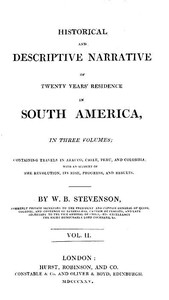
Historical and descriptive narrative of twenty years' residence in South America (Vol 2 of 3) Containing travels in Arauco, Chile, Peru, and Colombia; with an account of — Reading Companion
2
0
Project Gutenberg
2017
Peru -- Description and travel; Peru -- History -- War of Independence, 1820-1829; Ecuador -- Description and travel; Chile -- Description and travel; South America -- History -- Wars of Independence, 1806-1830
Readers of public-domain and historical texts
Project Gutenberg digital edition
en
Edition facts
Words: 98,575
Reading time: 429 min
Text sections: 9
Source:
Project Gutenberg record #55777
Stevenson's second volume shifts from coastal Peru into the northern provinces and Guayaquil, blending natural history with colonial administration. His prose alternates between precise entomological descriptions and sharp observations on labor, trade, and the social order under Spanish rule.
Editorial Edition Score
4.8/5
★★★★★
★★★★★
Calculated from edition completeness, EPUB availability, text structure and catalogue metadata. Not a user rating.
Edition quality
Stevenson opens this volume with a detailed account of the farm of Vinto, where he catalogs cattle, grain, and the first wheat in Peru with the eye of a practical agronomist. The narrative soon moves inland, tracing roads, villages, and mining operations in Caxatambo and Huailas. His voice is that of an informed observer—part traveler, part colonial secretary—who records the tapiales (mud fences) and the balsas (rafts) as readily as he notes the character of local inhabitants. The pace is deliberate, weighted by inventories of plants, animals, and minerals, yet it quickens when he turns to human activity: a feast, a burial, or the procession of St. Peter.
Entomology and the Colonial Gaze
Stevenson devotes surprising attention to insects and reptiles, describing the nigua (chigger) that burrows under the skin, the alacran (scorpion) whose sting causes fever and delirium, and the ciento pies (centipede) with its thirty joints. His language is clinical: the nigua deposits eggs that “increase to the size of a pea”; the scorpion’s tail is “armed with a small hooked instrument.” Yet he also notes local remedies—cauterizing with a lighted segar—and the widespread belief that tobacco smoke repels snakes. These passages reveal a writer who collects natural facts and cultural practices with equal curiosity, though he occasionally dismisses native fears as “fancy.” The contrast between empirical detail and colonial condescension marks his narrative voice throughout.
Labor, Independence, and the Dockyard
In Guayaquil, Stevenson shifts from natural history to political economy. The dockyard, he argues, “promotes labour, and consequently independence in a considerable portion of the inhabitants.” He praises the circulation of money and the value added to local wood through skilled work. The working mechanic, he writes, “can calculate with certainty on his earnings” and acquires “a personal independence, totally unknown where labour is scarce.” This is one of the volume’s most pointed social observations, linking economic activity to personal freedom—a theme that resonates with the revolutionary context hinted at in the title. The description of vessels built there, including the San Salvador of seven hundred tons, grounds his argument in concrete examples.
Itineraries and the Texture of Travel
The volume is structured around itineraries: from Lima to Truxillo, from Caxatambo to Chiquian, from Huaras to Conchucos. Stevenson lists distances, roads, and villages with the regularity of a logbook, but he also pauses for local color—the cura of Ocros, the repartimientos (forced distributions), the charquis (dried meat) and coca that sustain travelers. His prose can be dense with names and products, yet it never becomes a mere catalogue. The pace varies: a long enumeration of birds and minerals may be followed by a vivid scene, such as the representation of the Inca’s death. These shifts in tempo mirror the journey itself, where monotony and incident alternate, and where the observer’s attention moves from the ground beneath his feet to the society around him.
Readers should attend to Stevenson’s shifts in register—from the taxonomic to the anecdotal, from the economic to the ethnographic. His narrative is not a continuous story but a series of layered observations, each revealing a different facet of early nineteenth-century South America. The volume rewards those who read slowly, following the author’s own pace through provinces and ports, and noting where his voice grows more engaged or more detached.
Reader reflection
What was your reading experience?
Capture what you thought, learned, and would like to remember.
Your progress
0
/
10
2
What was your overall reaction to the book?
3
Is this a title you would suggest to others?
4
How easy was the book to follow?
5
How clearly were the main ideas presented?
6
How did the reading compare with what you expected?
7
Would this book work well in a reading group?
8
How original did the book feel?
9
Which lesson or insight stayed with you?
10