1

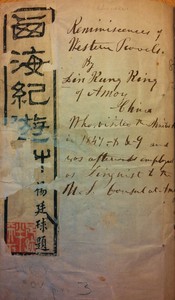
西海紀遊草 — Reading Notes
3
0
Project Gutenberg
2017
Voyages and travels; United States -- Description and travel
Readers of public-domain and historical texts
Project Gutenberg digital edition
en
Edition facts
Words: 8,023
Reading time: 35 min
Text sections: 2
Source:
Project Gutenberg record #54433
Lin Zhen's 1849 travelogue, the first by a Chinese visitor to the U.S., blends classical Chinese verse with American press reports, revealing a dual perspective on 1840s New York and the author's role as interpreter and cultural mediator.
Editorial Edition Score
4.5/5
★★★★★
★★★★★
Calculated from edition completeness, EPUB availability, text structure and catalogue metadata. Not a user rating.
Edition quality
Lin Zhen's Reminiscences of Western Travels (西海紀遊草) opens with a striking structural duality: the author's own classical Chinese poem and preface are followed by American newspaper accounts of the Chinese junk Keying and its crew. This juxtaposition creates a layered narrative where Lin's voice—formal, allusive, and condensed—contrasts sharply with the detailed, often sensational reporting of New York dailies. The work is not a continuous memoir but a collage of genres: verse, official reports, and third-person observations. Readers encounter Lin not as a solitary traveler but as a figure embedded in trans-Pacific networks—a linguist, a Christian convert, and a mediator between Chinese sailors and American institutions. The surviving copies differ significantly, reminding us that this text is itself a contested artifact.
A Poet in the Port City
Lin's own writing, concentrated in the opening poem and preface, employs the compressed imagery of classical Chinese verse. He describes his journey in terms of vast distances and cultural contrasts, but the excerpts offer only fragments of his direct observations. The poem's brevity—just a few dozen lines—suggests a selective, emblematic treatment of his experiences. In contrast, the American press reports that follow are expansive, naming specific streets (Cherry Street), ships (the bark Candace), and institutions (the Sailor's Home). This shift from lyrical economy to journalistic abundance marks the text's central tension: Lin's own voice is often mediated or submerged within the documentary record.
The Interpreter in the Archive
Lin appears in the American reports as "Lin-King-Chew," a figure described as "a devoted Christian" and "a Chinese gentleman of education." These accounts, written by missionaries and reporters, frame him as a benevolent guide who distributes Testaments and interprets for the sailors. Yet the excerpts also hint at his precarious position: he is "in a land of strangers," and the sailors beg their American hosts to care for him after they depart. The reports capture a moment of cultural translation—Lin explains Christian rituals, mediates legal troubles (an arrest is mentioned), and even interprets a sailor's wish to plant an American "cry tree" (willow) in China. This anecdote, with its blend of sentiment and botanical metaphor, reveals how Lin's role as interpreter shapes the narrative.
Pace and the Documentary Impulse
The text's pace shifts abruptly between Lin's condensed verse and the newspapers' chronological, event-driven prose. The poem moves in broad strokes; the reports linger on specific scenes: a church service, a farewell at Sandy Hook, a deputation of sailors. This alternation creates a rhythm of compression and expansion. The transcriber's note adds another layer, noting that the two extant copies differ significantly—one in private hands, one at the New York Public Library. The digital edition thus presents not a stable work but a version, chosen from competing sources. Readers should attend to these editorial choices, which affect what is included (e.g., which press reports) and how Lin's voice is framed.
Because the excerpts are incomplete, the full arc of Lin's journey—his departure from China, his return, and his later career as a U.S. consulate linguist—remains largely outside this record. The text rewards attention to its hybrid form: the interplay between Lin's own words and the American reports that surround them. Consider how each section constructs authority differently—the poem through tradition, the press through eyewitness detail—and what that reveals about the challenges of cross-cultural testimony in the mid-nineteenth century.
Reader reflection
Take a moment to reflect on this book
Create a short personal record of your experience with this book.
Your progress
0
/
10
2
Did this book hold your interest?
3
Would you recommend this book to another reader?
4
What was the reading difficulty like?
5
How understandable was the text?
6
How useful did the reading feel?
7
Is this a title worth rereading?
8
Did any part of the book feel personally relevant?
9
In one sentence, what did you learn?
10