1

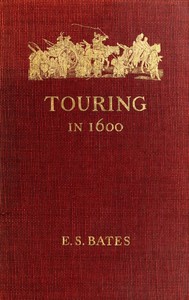
Touring in 1600: A Study in the Development of Travel as a Means of Education — Context and Discussion
2
0
Project Gutenberg
2015
Europe -- Description and travel; Europe -- Social life and customs; Travel -- History
Readers of public-domain and historical texts
Project Gutenberg digital edition
en
Edition facts
Words: 105,268
Reading time: 458 min
Text sections: 19
Source:
Project Gutenberg record #48594
An examination of early 17th-century European travel as an educational practice, drawing on contemporary guidebooks, diaries, and illustrations to reveal the logistics, dangers, and cultural encounters of tourists in 1600.
Editorial Edition Score
4.9/5
★★★★★
★★★★★
Calculated from edition completeness, EPUB availability, text structure and catalogue metadata. Not a user rating.
Edition quality
E. S. Bates's Touring in 1600 opens with a tourist's departure, then immediately grounds the reader in the period's travel infrastructure: guidebooks, water routes, inns, and the practicalities of the purse. The catalog subjects—European description, social life, and travel history—are broadly accurate, but the excerpts reveal a work far more concerned with the gritty mechanics of journeying than with scenic description. Bates draws heavily on contemporary accounts, such as those of the Italian traveler Pietro Della Valle, whose mummy-hunting at Saqqara is described in remarkable detail, including the price of three piastri per intact mummy and their eventual home in the Dresden Museum.
Guidebooks and the Shape of Knowledge
Bates devotes a full chapter to guidebooks and guides, a subject that the catalog subjects only hint at. The excerpts show that he is less interested in the accuracy of these works than in what they reveal about the traveler's mindset. He notes that cartography made great advances during the period, yet typical maps still omitted roads while indicating waterways. The guidebooks themselves mixed fact with legend: everything not credited to Pharaoh was put down to Joseph. Bates's analysis suggests that the educational value of travel lay not in objective geography but in the encounter with a world where knowledge was still being assembled.
The Tourist as Collector and Consumer
Bates presents tourism as a form of acquisition. Della Valle's mummy hunt is a prime example: he paid local boys to probe for tombs, brought away two intact mummies, and sold fragments to apothecaries. The passage notes that mummies were valued for medicinal properties, and that an Englishman named John Sanderson exported six hundred pounds of mummy fragments to London. Bates does not moralize, but the accumulation of such details—the fight among village boys for the privilege of guiding Della Valle, the use of mummy in paint—builds a picture of travel as a commercial and extractive enterprise.
The Perils of Pilgrimage and the Unvisited North
The catalog subject 'Europe — Social life and customs' is most visible in Bates's treatment of pilgrimage. The journey to Mount Sinai, he writes, was so terrible that no one went a second time. Travelers depended on the goodwill of Arabs, faced privation, and were pelted with dirt and bad lemons by Cairo boys. Yet Bates also includes a chapter on 'The Unvisited North' and 'The Misunderstood West,' suggesting that the tourist's Europe was a narrow corridor. The excerpts do not detail these regions, but the implication is clear: the educational tour of 1600 was as defined by what it ignored as by what it sought.
Readers should approach Touring in 1600 as a work of historical reconstruction that privileges the traveler's own words and the material conditions of the journey. Bates's method is to compile and juxtapose, letting the sources speak. The result is a study that feels less like a narrative and more like a cabinet of curiosities—fitting for a subject where the line between education and exploitation was often blurred.
Reader reflection
What was your reading experience?
Capture what you thought, learned, and would like to remember.
Your progress
0
/
10
2
Was reading this book enjoyable?
3
Would you encourage someone else to read it?
4
How much effort did this book require?
5
Was the book moving at the right speed?
6
Would you start a conversation about this book?
7
Could you see yourself revisiting this book?
8
How useful were the ideas in this book?
9
What is the main idea you are taking away?
10