1

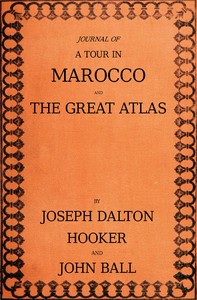
Journal of a tour in Marocco and the Great Atlas — Text and Context
2
0
Project Gutenberg
2023
Morocco -- Description and travel; Plants -- Morocco; Geology -- Morocco; Atlas Mountains
Readers of public-domain and historical texts
Project Gutenberg digital edition
en
Edition facts
Words: 174,981
Reading time: 761 min
Text sections: 23
Source:
Project Gutenberg record #70700
This editorial note examines the structure, recurring images, and scene transitions in Hooker and Ball's 1871 expedition journal, focusing on how geological and botanical observations shape the narrative movement through Morocco's Atlas Mountains.
Editorial Edition Score
4.9/5
★★★★★
★★★★★
Calculated from edition completeness, EPUB availability, text structure and catalogue metadata. Not a user rating.
Edition quality
The journal alternates between detailed geological descriptions and botanical cataloguing, with movement between valleys serving as the primary structural device. The authors explicitly compare the Aït Mesan and Amsmiz valleys, noting differences in rock composition—red sandstones versus schistose strata—and corresponding shifts in vegetation. This pattern of observation, comparison, and inference recurs throughout the excerpts, creating a rhythm of travel, examination, and analysis.
The narrative voice is collaborative yet distinct: Hooker's initial notes were later completed by Ball, who supplemented them with Maw's geological appendix. The preface acknowledges this layered authorship, which may account for the text's careful cross-referencing between botanical lists and geological sketches.
Geological Framing of Landscape
The journal consistently uses geological structure as a lens for understanding the landscape. In the Amsmiz valley, the authors note that “the character of the rocks throughout this valley is altogether different from that of the more lofty range which we had previously visited.” This observation leads them to anticipate changes in flora, demonstrating how geological expectations shape botanical inquiry. The text frequently describes strata, dykes, and mineral composition before turning to plant life, suggesting a methodological priority: the physical foundation of the terrain must be understood before its living cover can be interpreted.
Recurring images of rock types—red sandstones, calcareous schists, porphyry intrusions—anchor the narrative in tangible, observable features. These details are not mere description; they serve as evidence for broader claims about moisture retention, altitude effects, and biogeographical connections to Southern Spain and Algeria.
Botanical Comparisons Across Valleys
The authors employ comparative botany as a structural motif. They quantify differences between valleys: “only seventy-six species seen by us were confined to the Amsmiz valley, that nearly twice as many were found common to both valleys, while more than three times that number were seen in Aït Mesan.” This numerical precision reflects a scientific approach to narrative, where observations are tabulated and analyzed.
The text also notes affinities with other regions: “the greater resemblance which it bears to that of the mountains of Southern Spain than does that of the Aït Mesan valley.” Such comparisons situate local findings within a broader biogeographical framework, hinting at patterns the authors cannot fully verify due to limited access. The mention of “undescribed forms” and “nearest allies” underscores the provisional nature of their conclusions.
Encounters with Local Inhabitants
Interactions with local people are brief but revealing. In one village, the sheik orders Shelluh inhabitants to keep aloof, while Jewish families are “clearly well disposed towards the Christian strangers.” A Jewish man volunteers to guide the party, but language barriers limit communication: “Conversation either in Hebrew or Shelluh being unfortunately out of the question.”
These encounters highlight the constraints on the travellers’ knowledge. They cannot interview locals about plants or geology; their understanding is mediated by observation alone. The journal’s structure reflects this limitation: human interactions are episodic and secondary to the natural phenomena that dominate the narrative. The authors’ frustration is implicit in the phrase “we could not fail to be struck with the man’s air of intelligence and friendliness,” suggesting a desire for exchange that the expedition’s circumstances prevented.
Movement as a Narrative Device
The journal’s structure is driven by physical movement: from one valley to another, from lower slopes to higher ridges, from morning rides to afternoon herborisations. Transitions are marked by shifts in geological and botanical description, creating a sense of progressive discovery. For example, the authors note that “we were led by the difference in geological structure to anticipate a considerable change in the flora,” and this expectation is confirmed by subsequent observations.
Recurring images of pine cones and the absence of true conifers build suspense: “up to this we had not seen a true conifer in Marocco.” Such details create a narrative arc within the scientific report, where each new location offers the possibility of unexpected finds. The text’s movement between valleys thus mirrors the exploratory logic of the expedition itself.
Readers attentive to the journal’s structure will notice how geological and botanical observations are interwoven with the physical progress of the journey. The authors’ habit of comparing each new site with previous ones—quantitatively and qualitatively—gives the narrative a cumulative, analytical texture. While the excerpts do not reveal the expedition’s ultimate conclusions, they demonstrate a method of inquiry that treats landscape as a layered text to be read through careful, comparative observation.
Reader reflection
Your personal reading reflection
Build a private reading journal entry for this title.
Your progress
0
/
10
2
How much did you enjoy the reading experience?
3
Is this a title you would suggest to others?
4
How demanding did the text feel?
5
Was the book easy to understand?
6
Would you like to discuss this book with someone?
7
Did the book deliver what you hoped for?
8
Is this a title worth rereading?
9
What did this book teach you most?
10