1

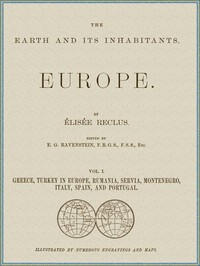
The Earth and its inhabitants, Volume 1: Europe. Greece, Turkey in Europe, Rumania, Servia, Montenegro, Italy, Spain, and Portugal. — Reading Companion
2
0
Project Gutenberg
2017
Europe -- Description and travel; Geography
Readers of public-domain and historical texts
Project Gutenberg digital edition
en
Edition facts
Words: 214,575
Reading time: 933 min
Text sections: 93
Source:
Project Gutenberg record #54760
Elisée Reclus's 1883 geography of southern Europe blends physical description with historical and economic analysis, using precise observations on malaria, drainage, and population to reveal how human intervention shapes landscape and health.
Editorial Edition Score
4.9/5
★★★★★
★★★★★
Calculated from edition completeness, EPUB availability, text structure and catalogue metadata. Not a user rating.
Edition quality
Elisée Reclus opens his survey of southern Europe not with grand landscapes but with a precise, almost clinical attention to the relationship between human activity and environmental conditions. In the Maremma region of Tuscany, he notes that the ancient Etruscans built subterranean canals to drain swamps, but after their subjugation, these works decayed and malaria returned. Reclus tracks the disease's incidence by elevation—325 feet above sea level offers some safety—and by wind exposure, observing that places open to sea breezes remain healthy even near swamps. This interplay of engineering, politics, and epidemiology sets the tone for a work that treats geography as a dynamic, human-influenced system.
A Narrative of Decline and Renewal
Reclus structures his regional accounts around cycles of prosperity and decay, often linking them to political history. In the Maremma, he describes how Massa Maritima was “rich and populous” under republican rule but declined to a “shadow of a town” after being enslaved by Pisans and Sienese, as drainage works were neglected. The monasteries, he notes, opposed embankments because they valued fish-ponds for Lenten food. Even the Spanish crown established a penal colony at Talamone, where banishment was “tantamount to a sentence of death.” These details are not mere asides; they form a recurring argument that human governance and infrastructure directly shape the salubrity and productivity of a region. Reclus does not simply describe what is—he explains how it came to be, and often contrasts past vitality with present decay.
Voice and Evidentiary Style
Reclus's narrative voice is that of a detached but engaged observer, blending statistical data with vivid, almost anecdotal evidence. He cites specific figures—36,000 fever cases out of 80,000 inhabitants in 1840–41—alongside local opinions, such as Salvagnoli Marchetti's theory that fevers arise from “empyreumatic substances” in clayey soils. He also draws on historical records, noting that ancient Tyrrhenian cities could not have existed under current malarial conditions. This layering of quantitative and qualitative sources gives the text a persuasive, cumulative force. The prose is direct and unadorned, avoiding florid description in favor of factual density. When Reclus writes that “the inhabitants never reach a high age,” the statement carries weight because it is anchored in the preceding enumeration of deaths and diseases.
Pace and Thematic Focus
The pace of the excerpt is deliberate, moving from general observation to specific case studies and back again. Reclus begins with a broad statement about Viareggio's transformation from an unhealthy hamlet to a seaside resort, then narrows to the Maremma's persistent insalubrity, then widens to discuss the historical drainage works of the Etruscans. This rhythm—macro to micro to macro—allows him to sustain a thematic focus on human impact without losing local texture. The passage on malaria is not an isolated digression; it exemplifies how Reclus integrates physical geography, history, and public health into a single analytical frame. The result is a geography that reads less like a catalogue of facts and more like an argument about the interdependence of people and place.
Readers approaching this volume should expect a geography that is as much about history and political economy as about mountains and rivers. Reclus's method—moving from specific, often grim details to broader patterns—rewards careful attention. The maps and engravings mentioned in the contents are integral to his argument, so consulting them alongside the text will deepen understanding of how he visualizes the relationships he describes.
Reader reflection
Before you leave, reflect on the book
Use these questions to collect your thoughts before moving on.
Your progress
0
/
10
2
Was reading this book enjoyable?
3
How likely are you to recommend this book?
4
How much effort did this book require?
5
Did it raise ideas you would like to talk about?
6
Did the book deliver what you hoped for?
7
Which aspect of the book did you value most?
8
Did any part of the book stay with you emotionally?
9
What changed or sharpened your thinking?
10