1

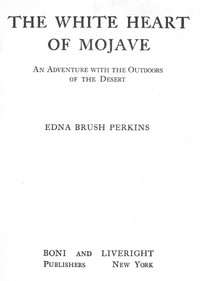
The White Heart of Mojave: An Adventure with the Outdoors of the Desert — Story, Setting & Ideas
2
0
Project Gutenberg
2019
Perkins, Edna Brush -- Travel -- California; Landscapes -- California -- Mojave Desert; Landscapes -- Death Valley (Calif. and Nev.); Mojave Desert -- Description and travel; Death Valley (Calif. and Nev.) -- Description and travel
Readers of public-domain and historical texts
Project Gutenberg digital edition
en
Edition facts
Words: 45,278
Reading time: 197 min
Text sections: 5
Source:
Project Gutenberg record #60078
Edna Brush Perkins's 1922 desert travelogue uses precise, sensory language to convey the Mojave's scale and indifference. The narrative contrasts human frailty with the desert's overwhelming beauty, focusing on the author's struggle to articulate the experience.
Edna Brush Perkins opens The White Heart of Mojave not with a landscape but with a meditation on walls. The first chapter, “The Feel of the Outdoors,” argues that walls—of houses, offices, cities—domineer, insisting on their own importance while the sky and seasons are treated as mere accessories. This framing immediately establishes the book’s central tension: the desert’s vastness versus the human tendency to enclose and control. Perkins’s prose is alert to the psychological effects of space, noting how a view from a skyscraper window can transform roofs into “romance” until “jealous walls” reassert themselves. The desert, then, becomes a place where walls fall away, leaving the traveler exposed to a beauty that is “too terrible and too splendid.”
Diction of Scale and Indifference
Perkins repeatedly chooses words that emphasize the desert’s enormity and its disregard for human presence. The valley is “too terrible and too splendid”; the nights and days pass “perfect for its own sake, and utterly indifferent.” She describes the landscape as a “white terror” and a “pageant which passed too quickly and was too big for our understanding.” This diction does not merely describe—it enacts a relationship. The desert is not a backdrop but an active force, one that “asserts itself tremendously.” The author’s vocabulary of scale—stupendous, enormous, majestic—is paired with words of limitation: tongue-tied, bewildered, prisoners. The effect is a landscape that dwarfs language itself.
The Dialogue of Frustration and Sarcasm
Perkins’s traveling companion, referred to as “the Worrier,” provides a counterpoint of practical skepticism. When the author insists on hauling beds to a hilltop to watch sunset, the Worrier asks, “Why don’t you take them to the top of that there peak?”—pointing sarcastically at a distant crest. The exchange reveals a quiet comedy of mismatched priorities: one character seeks aesthetic immersion, the other efficiency. Perkins does not editorialize; she lets the Worrier’s laconic tone speak for itself. This understated dialogue grounds the narrative, preventing the sublime from becoming precious. It also hints at the social dynamics of early-twentieth-century desert travel, where the demands of survival—water, shade, rest—constantly interrupt the desire for contemplation.
Structure: The Rhythm of Endurance and Enchantment
The book’s chapters follow a pattern of approach, ordeal, and reluctant departure. In “The Burning Sands,” Perkins writes that from ten in the morning until four in the afternoon, she and her companion “existed in a blind torpor.” At noon they plan to leave; then “the enchantment would begin and we would forget all the plans.” This oscillation between suffering and captivation is the book’s structural engine. The desert is not a static wonder but a cycle of repulsion and attraction. Perkins does not resolve this tension; she lets it stand as the defining experience of the Mojave. The reader is left with the sense that the desert’s power lies precisely in its ability to make endurance and awe inseparable.
Recurring Details: Color, Light, and the Limits of Sight
Perkins returns obsessively to color, especially blue. In one passage, the night is “a succession of studies in blue,” with “layers of different blues” that change and mingle. The stars are “enormous” and “hung in the sky like great lamps.” Yet this visual richness is always paired with a sense of failure: “We were like prisoners shut in by the walls of ourselves, unable to break through and be one with such beauty.” The author’s eye is acute, but her language repeatedly confesses inadequacy. The desert exceeds the imagination “every way.” This recurring motif—the insufficiency of sight and speech—gives the travelogue a modernist edge. It is not a triumphant conquest of landscape but a record of being overwhelmed.
The Human Scale: Fragility and Persistence
Throughout the excerpts, Perkins contrasts the desert’s permanence with human transience. The ranch in Death Valley is a “green patch” that seems “more ephemeral and unimportant than any of man’s efforts to tame the desert”; it is “an unreality, a dream.” The dwellers are “shadows in a dream.” Yet the author and her companion persist, climbing cliffs, hauling beds, enduring heat. This persistence is not heroic but almost absurd—a stubborn refusal to be dismissed. Perkins’s tone is wry, self-aware. She knows that the desert will outlast any human gesture, but she makes the gesture anyway. The book’s quiet power lies in this acknowledgment of futility paired with continued effort.
Perkins’s prose rewards attention to its small, precise choices: the way she uses domineer for walls, tongue-tied for awe, or sarcastically for the Worrier’s practicality. The desert she presents is not a place to be conquered or even fully understood, but one to be endured and recorded in fragments. Readers should approach the text as a series of impressions rather than a continuous narrative—a diary of sensory overload and quiet comedy, where the real adventure is the attempt to find words for what resists them.
Reader reflection
How did this book work for you?
Your answers remain private and are stored only in this browser.
Your progress
0
/
10
2
How much did you enjoy the reading experience?
3
Is this a title you would suggest to others?
4
How easy was the book to follow?
5
Did the book offer a fresh perspective?
6
How did the reading compare with what you expected?
7
Would this book work well in a reading group?
8
What did you appreciate most?
9
What did this book teach you most?
10