1

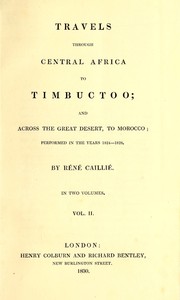
Travels through Central Africa to Timbuctoo; and across the Great Desert, to Morocco, performed in the years 1824-1828, Vol. 2 (of 2) — Background and Themes
27
15
Project Gutenberg
2023
Sudan (Region) -- Description and travel; Sahara -- Description and travel
Readers of public-domain and historical texts
Project Gutenberg digital edition
en
Edition facts
Words: 138,026
Reading time: 601 min
Text sections: 16
Source:
Project Gutenberg record #70011
René Caillié's second volume recounts his perilous journey from Timbuctoo across the Sahara to Morocco, based on hastily written notes that he later reconstructed from memory. The narrative reveals the constant threat of discovery as a Christian traveler disguised as a Muslim, and the physical hardships of desert travel.
Editorial Edition Score
4.9/5
★★★★★
★★★★★
Calculated from edition completeness, EPUB availability, text structure and catalogue metadata. Not a user rating.
Edition quality
Caillié's preface immediately establishes the precariousness of his enterprise: his notes were written "in haste and trepidation," and he carried "a sentence of death" in his wallet. The narrative that follows is a reconstruction from memory, as the original pencil marks were effaced by time and travel. This self-awareness about the fragility of his record shapes every page.
The journey across the Sahara is marked by relentless physical strain. Caillié describes his limbs bending under him, his courage failing, and the need to beg for dates and water from fellow travelers. The landscape is consistently barren—"arid and stony mountains," "complete sterility," and villages where water must be paid for with scarce dates. These details ground the narrative in tangible hardship.
The Peril of Writing
Caillié's preface reveals the extraordinary circumstances under which his notes were produced. He explains that in regions occupied by the Foulahs and Moors, "religious hypocrisy in a stranger is the most flagrant of outrages." To be discovered writing unknown characters would have been fatal. His notes were therefore "fugitive and very laconic," written in pencil and hidden. Upon returning to Paris, he found them so faint that he had to rely on "the tenacity and the scrupulous fidelity of my memory" to restore them. This admission colors the entire volume: the reader encounters not a contemporaneous diary but a retrospective account, filtered through the author's recollection and his desire for accuracy. Caillié insists that "scrupulous fidelity" is the principal merit of his work, yet the reader must remain aware of the gap between event and record.
Daily Exhaustion and Subsistence
The excerpts from the journey itself are dominated by the struggle for basic sustenance. Caillié repeatedly notes his lack of food: "I had nothing whatever to eat," "I determined to beg some" dates, and later "I had no more, and was obliged to have recourse to charity for a draught." The charity is not always forthcoming; he records being "repulsed like a dog" by Moors who told him to drink at the fountain. The caravan's pace is punishing: setting out at five in the morning, traveling through intense heat, and arriving at villages only to find the landscape "sterile and dry." Even when bread is obtained, it is often "baked a second time" and eaten with water. These details accumulate to create a portrait of a traveler perpetually on the edge of physical collapse, sustained only by the occasional gift from a fellow traveler or a host.
Landscape of Barrenness
Caillié's descriptions of the terrain are consistently bleak. He notes "high mountains wholly destitute of vegetation," "complete sterility" except for a few cork-trees, and "arid and stony mountains" that make the ascent a "terrible task." The plain around L-Guim is described as "sterile and dry; not a single tree is to be seen." Even when cultivation appears, as at L-Eksebi, it is limited to a few olive-trees and a well-watered plain. The recurring motif is scarcity: water is distant, dates are dear, and forage is minimal. The Berbers and Arabs encountered along the way are often reduced to begging for dates themselves. This environmental harshness is not merely backdrop but a central actor in the narrative, dictating the pace of travel and the availability of aid.
Encounters with Authority and Custom
The journey is punctuated by interactions with local authorities and customs. At L-Eksebi, the Moors open a market where bread, meat, raisins, and figs are sold by weight, and a caravansera lodges travelers for a small fee for animals only—men sleep on the ground. The caravan is stopped four times in one day by Arabs demanding "passage dues" paid in dates and bread, acting under the sultan's orders. Some Berbers spread a cloth beside the road to receive dates as alms. These encounters reveal a structured system of travel: tolls, markets, and hospitality are all governed by local norms. Caillié, as a disguised traveler, must navigate these without revealing his true identity. His observations are precise about the customs—the weighing of food, the payment in kind, the hierarchy of travelers—but he never comments on his own deception, leaving the reader to infer the constant risk.
Reading this volume, one should attend to the tension between Caillié's claim of scrupulous fidelity and the admitted reconstruction of his notes. The narrative's power lies in its accumulation of concrete, often grim details: the weight of dates, the heat of the sun, the sting of rejection. These are not embellished for drama but presented as the fabric of daily survival. The reader is invited to trace the author's physical and psychological trajectory through a landscape that offers no respite, and to consider how memory reshapes even the most carefully preserved record.
Reader reflection
What did you think of this book?
Answer a few questions and save a private reflection on this device.
Your progress
0
/
10
2
How did the book work for you overall?
3
Is this a title you would suggest to others?
4
Did the language feel accessible?
5
Which aspect of the book did you value most?
6
How valuable was this book for your own interests?
7
How personally connected did you feel to the book?
8
Did any part of the book stay with you emotionally?
9
What changed or sharpened your thinking?
10