1

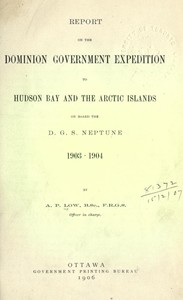
Report on the Dominion Government Expedition to Hudson Bay and the Arctic Islands on board the D.G.S. Neptune, 1903-1904 — Inside the Classic
23
15
Project Gutenberg
2017
Canada -- Discovery and exploration; Neptune (Steamship); Hudson Bay Region -- Description and travel; Arctic Archipelago (Nunavut and N.W.T.) -- Description and travel
Readers of public-domain and historical texts
Project Gutenberg digital edition
en
Edition facts
Words: 112,154
Reading time: 488 min
Text sections: 21
Source:
Project Gutenberg record #55479
A.P. Low's official report of the 1903-1904 Dominion Government Expedition aboard the D.G.S. Neptune, blending scientific survey with ethnographic observations of Inuit communities in Hudson Bay and the Arctic Islands.
Editorial Edition Score
4.9/5
★★★★★
★★★★★
Calculated from edition completeness, EPUB availability, text structure and catalogue metadata. Not a user rating.
Edition quality
The report opens with a formal letter of transmittal dated September 8, 1905, addressed to the Minister of Marine and Fisheries. Low acknowledges the assistance of Colonel F. Gourdeau, Commander G. O. V. Spain, and Captain S. W. Bartlett, among others. He credits the scientific staff—Dr. L. E. Borden, naturalist Andrew Halkett, and topographer C. F. King—for their contributions. The tone is official and appreciative, establishing the expedition as a collaborative government venture. Low also thanks Dr. Robert Bell and staff of the Geological Survey for help in preparing the report, noting that the accompanying map was directed by C. O. Senécal. This opening frames the work as a comprehensive, multi-author document grounded in systematic observation.
Ethnographic Detail in Song and Ceremony
The excerpts include a vivid description of an Inuit song performance. Low records that after each line, a chorus of two lines is sung, resembling “Ai yea yae yaeyaeya yae” repeated twice. The singer dances and hops, occasionally uttering “we-hew! we-hew!” The song is the man’s own composition, in rough metre without rhyme, and its sentiments are “at times poetic.” In the observed song, praise was given to springtime, longing for its arrival, mention of women’s childbirth trials, and wishes for hunters’ luck. The performance lasted over an hour. A visiting Kenipitu from Chesterfield Inlet was invited to sing; he thanked the donor of a hatchet, described his home country, and expressed a wish to be a successful hunter, deprecating waste of animals. Low notes that the singer became exhausted and hoarse. He fled the scene due to “foul air and pungent odour.” This passage reveals Low’s dual role as observer and participant, balancing ethnographic interest with personal limits.
Garments and Material Culture
Low provides a detailed account of Inuit winter and summer garments. Winter clothing is made from deerskin when available; otherwise sealskin, fox, wolf, bear, dog, or bird skins are used. Summer garments are typically sealskin, while waterproof clothing comes from the intestines of the big seal. Both sexes wear a coat, breeches, stockings, and boots. In winter, two suits are worn: an inner with hair next to the body, an outer with hair exposed. The man’s coat, or kulitang, descends below the hips, has no openings, and is drawn on over the head. It features a hood with a drawing string and a fringe of deerskin thongs that entangles with the lower garment as a wind-break. Low notes regional variation: on the east side of Hudson Bay coats are moderate length; among northern Greenland Eskimos they are short, exposing the back when bending. This systematic description reflects the report’s scientific approach to material culture.
Social Dynamics and Change
Low observes that songs sometimes ridicule neighbours, and an Eskimo’s joke is “often much broader than it is pointed,” which can breed ill-feeling. Consequently, Christianized Eskimos on the east side of Hudson Bay no longer indulge in this amusement but sing hymns instead. This note indicates cultural change due to missionary influence. Low also mentions that during men’s hunting absences, women sometimes engage in a form of female “angekoking” accompanied by “very obscene rites, which were better left unrecorded.” This remark shows Low’s discretion and the limits of his ethnographic reporting. The passage underscores the report’s value as a record of both traditional practices and the impact of external contact.
Structure and Voice of the Report
The report’s structure blends official documentation with personal narrative. The opening letter establishes a chain of command and credit, while later sections shift to first-person observation. Low’s voice is precise and often dry, but occasionally reveals personal reactions—such as fleeing the song ceremony. The scientific staff’s contributions are acknowledged, but the ethnographic passages are clearly Low’s own. The report includes topographical work by King, natural history collections by Halkett, and medical care by Borden, yet the excerpts focus on Low’s direct encounters. This mix of formal reportage and anecdotal detail gives the work a hybrid character, part government document and part travelogue. Readers should note that the excerpts are incomplete; the full report likely contains extensive geographical and scientific data not represented here.
The excerpts offer a focused view of Low’s ethnographic observations, but the complete report spans over 112,000 words covering navigation, geology, and biology. Readers interested in the expedition’s full scope should expect detailed logs, maps, and scientific appendices. Low’s attention to Inuit song, clothing, and social customs provides a valuable snapshot of early 20th-century Arctic life, though his perspective is that of an outsider and government official. Approach the text as a primary source shaped by its era’s colonial and scientific frameworks.
Reader reflection
Before you leave, reflect on the book
Use these questions to collect your thoughts before moving on.
Your progress
0
/
10
2
How did the book work for you overall?
3
Would you encourage someone else to read it?
4
How demanding did the text feel?
5
Was the book moving at the right speed?
6
Did you gain anything practical from the text?
7
Which element worked best for you?
8
How closely did the book connect with your experience?
9
What changed or sharpened your thinking?
10