1

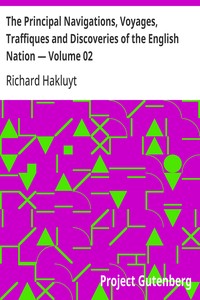
The Principal Navigations, Voyages, Traffiques and Discoveries of the English Nation — Volume 02 — Edition Insights
23
15
Project Gutenberg
2005
Voyages and travels; Discoveries in geography -- English
Readers of public-domain and historical texts
Project Gutenberg digital edition
en
Edition facts
Words: 85,926
Reading time: 374 min
Text sections: 7
Source:
Project Gutenberg record #7466
This volume of Hakluyt's collection focuses on northeastern Europe and Tartary, featuring firsthand accounts of Mongol diplomacy and the Muscovy Company's early ventures. The excerpts reveal a tension between the catalog subject 'Discoveries in geography -- English' and the actual content, which includes Latin transcriptions, Russian intermediaries, and a European perspective on Tartar customs.
Editorial Edition Score
4.8/5
★★★★★
★★★★★
Calculated from edition completeness, EPUB availability, text structure and catalogue metadata. Not a user rating.
Edition quality
The second volume of Hakluyt's collection, subtitled 'Northeastern Europe, and Adjacent Countries. Part I. Tartary,' opens not with English voyages but with a letter recorded by Matthew Paris, in which an Englishman describes the Tartars as 'the rod of Gods anger.' This framing—a European account of a non-European power—sets the tone for a volume that often subordinates English discovery to the logistics of diplomacy and translation.
The excerpts show Hakluyt's method: he includes Latin originals alongside English translations, and his editorial apparatus (sidenotes, marginal notes) draws attention to figures like 'Cosmas a Russian' and 'Chingay his chief Secretary.' The catalog subjects 'Voyages and travels' and 'Discoveries in geography -- English' only partially capture this volume's interest in the mechanics of cross-cultural communication.
Translation as a Recurring Motif
The excerpts repeatedly foreground the problem of language. In the letter from 'Yuo of Narbona,' the Tartars demand interpreters for Russian, Saracen, and Tartarian tongues. Later, the friars describe how Kadac, Chingay, and Bala 'interpreted the letter word for word' and then 'caused vs to interprete vnto them eche sentence.' This is not a simple travel narrative; it is a record of how information was negotiated.
Hakluyt's own editorial choices reinforce this theme. He prints the Latin version of the friars' report alongside the English, and his sidenotes highlight the names of scribes and translators. The volume thus becomes a meta-document about the conditions under which geographical knowledge was produced—conditions that involved mistrust, scarcity, and the need for intermediaries like the Russian goldsmith Cosmas.
The Catalog Subject vs. The Actual Content
The Project Gutenberg catalog lists 'Discoveries in geography -- English' as a subject, but the excerpts in this volume are not primarily about English exploration. The letter from Matthew Paris is an Englishman's confession about Tartar behavior, not an account of an English voyage. The friars' narrative is a mission to the Mongol emperor, not a discovery narrative. Even the volume's title—'Northeastern Europe, and Adjacent Countries. Part I. Tartary'—suggests a geographic scope that the excerpts only partially fulfill.
What the excerpts do show is the English interest in the political and commercial structures of regions they hoped to access. The Muscovy Company appears in the volume's subtitle, but the actual text dwells on the Tartar court's procedures: the setting up of a 'flag of defiance,' the scrutiny of letters, the control of food supplies. The catalog subject 'Voyages and travels' is accurate, but the emphasis falls on the obstacles to travel rather than the travel itself.
Material Conditions of the Journey
The excerpts are unusually frank about the physical hardships of the journey. The friars report 'extreme hunger and thirst' and note that 'the prouision allowed vs for foure dayes, was scantly sufficient for one day.' They cannot buy food because 'the market was too farre off.' These details are not embellished for drama; they are presented as practical obstacles that shape the narrative.
Hakluyt's editorial apparatus—the sidenotes identifying 'Cosmas a Russian' and 'the message of Chingay'—directs the reader to the human infrastructure that made such journeys possible. The volume thus offers a corrective to the idea of discovery as a solitary English endeavor. Instead, it shows a network of translators, local guides, and court officials whose cooperation was essential, and whose absence could mean failure.
Readers approaching this volume expecting straightforward accounts of English exploration will find instead a collection that foregrounds the diplomatic and linguistic labor behind geographical knowledge. The excerpts reward attention to Hakluyt's editorial choices—the inclusion of Latin texts, the placement of sidenotes—as much as to the narratives themselves. The volume is best read as a document of how Europeans processed encounters with powers they could not control, and how those encounters were recorded for an English audience.
Reader reflection
How did this book work for you?
Your answers remain private and are stored only in this browser.
Your progress
0
/
10
2
Was reading this book enjoyable?
3
Is this a title you would suggest to others?
4
Did the language feel accessible?
5
How closely did the book connect with your experience?
6
How did the pace of the book feel?
7
Could you apply anything you learned?
8
Could you follow the author’s main argument?
9
In one sentence, what did you learn?
10