1

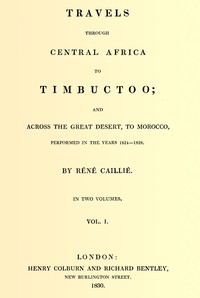
Travels through Central Africa to Timbuctoo; and across the Great Desert, to Morocco, performed in the years 1824-1828, Vol. 1 (of 2) — Inside the Classic
2
0
Project Gutenberg
2023
Sudan (Region) -- Description and travel; Sahara -- Description and travel
Readers of public-domain and historical texts
Project Gutenberg digital edition
en
Edition facts
Words: 173,093
Reading time: 753 min
Text sections: 14
Source:
Project Gutenberg record #69847
René Caillié's 1830 account of his 1824-1828 journey to Timbuctoo, based on his own observations, opens with a French perspective on British exploration failures and proceeds through detailed descriptions of landscapes, villages, and cultural practices in Central Africa.
The advertisement that precedes René Caillié's narrative frames his achievement as a national triumph: while British expeditions led by Houghton, Park, and Laing had failed or perished, a Frenchman of modest means succeeded in reaching Timbuctoo. This competitive edge sets the tone for a work that is both a personal travelogue and a contribution to geographical knowledge. Caillié's account, first published in 1830, relies on his own observations during his 1824-1828 journey, and the excerpts show a writer attentive to physical details—soil composition, distances, and the layout of villages—as well as to social interactions with local leaders and merchants.
A Traveller's Precarious Encounters
In the excerpt from Chapter IX, Caillié describes arriving at Bacocouda, where he and his guide seek lodging from the chief. The scene is charged with tension: he recognizes Saracolet merchants who had passed through Cambaya, and one addresses him in Arabic. Caillié's response—answering questions, then being given a sheep-skin to sit on—reveals his strategy of passing as an Arab. The merchant later admits he initially took Caillié for a Christian, but now believes him an Arab. This moment of mistaken identity is central to the narrative's suspense. Caillié's gift of tobacco and promise of scissors to the merchant shows how small bribes oiled his passage. The chief's approval of his resolution, as relayed by the guide, suggests that Caillié's story of his adventures was crafted to win local sympathy.
Martial Dances and the Threat of Insult
That evening, the village stages martial dances that Caillié observes with a mixture of fascination and fear. He describes the tambourines with sticks, bells, and strings of sheep's gut, and the songs that exhort warriors to fight. The dancers mimic combat with sabres, bows, and muskets, discharging weapons in a display of victory. Caillié notes that he returned to his hut after a short time, afraid of being insulted. His guide Lamfia later explains that the dance represents war against infidels. This episode illustrates how Caillié's position as a European Christian in disguise made him vulnerable; even a cultural performance could feel threatening. His careful documentation of the instruments and choreography, however, shows his ethnographic eye at work, recording details that later readers would find valuable.
Landscape and Livelihood Along the Niger
Caillié's route takes him through Baléya, described as having argillaceous sand that is compact but fertile. He crosses streams flowing north into the Niger, and notes a chain of mountains separating Baléya from Bouré. The woods are infested with robbers, a constant hazard. At Bacocouda, a village of five to six hundred inhabitants, he observes the chief seated on a bullock's hide, a detail that conveys local authority. The people offer white yams boiled for supper, a simple meal that contrasts with the elaborate dances later. Caillié's attention to agricultural and geographical specifics—the soil type, the direction of streams, the size of settlements—grounds his narrative in observable reality, lending credibility to his account of regions then largely unknown to Europeans.
The Role of Guides and Local Intermediaries
Throughout the excerpts, Caillié relies on his guide Lamfia, who negotiates with chiefs and explains local customs. When the chief sends supper, it is Lamfia who gives an account of Caillié's adventures. The guide also borrows a musket for the dancers, showing how Caillié's possessions were integrated into village life. The Saracolet merchant proposes to conduct Caillié to Ségo, offering a route via water to Jenné—a plan Caillié welcomes. These interactions highlight the network of local knowledge and assistance that made his journey possible. Caillié's narrative does not romanticize his independence; instead, it shows him constantly dependent on the goodwill and guidance of Africans, whose motives he interprets with caution but whose practical help he acknowledges.
Readers approaching this first volume should attend to the interplay between Caillié's self-presentation as a humble Frenchman and his actual reliance on disguise and bribery. The excerpts reveal a traveller who is both an observer and a performer, constantly reading social cues to avoid exposure. The detailed descriptions of landscape and custom are not mere background; they are the evidence Caillié offers to substantiate his claim to have reached Timbuctoo. As you read, note how he balances the need for scientific precision with the narrative of personal survival.
Reader reflection
What did you think of this book?
Answer a few questions and save a private reflection on this device.
Your progress
0
/
10
2
Was reading this book enjoyable?
3
Is this a title you would suggest to others?
4
How much effort did this book require?
5
Did the book deliver what you hoped for?
6
Did you relate to its people, ideas, or situations?
7
How distinctive were its ideas or approach?
8
How useful did the reading feel?
9
What changed or sharpened your thinking?
10